Forecast
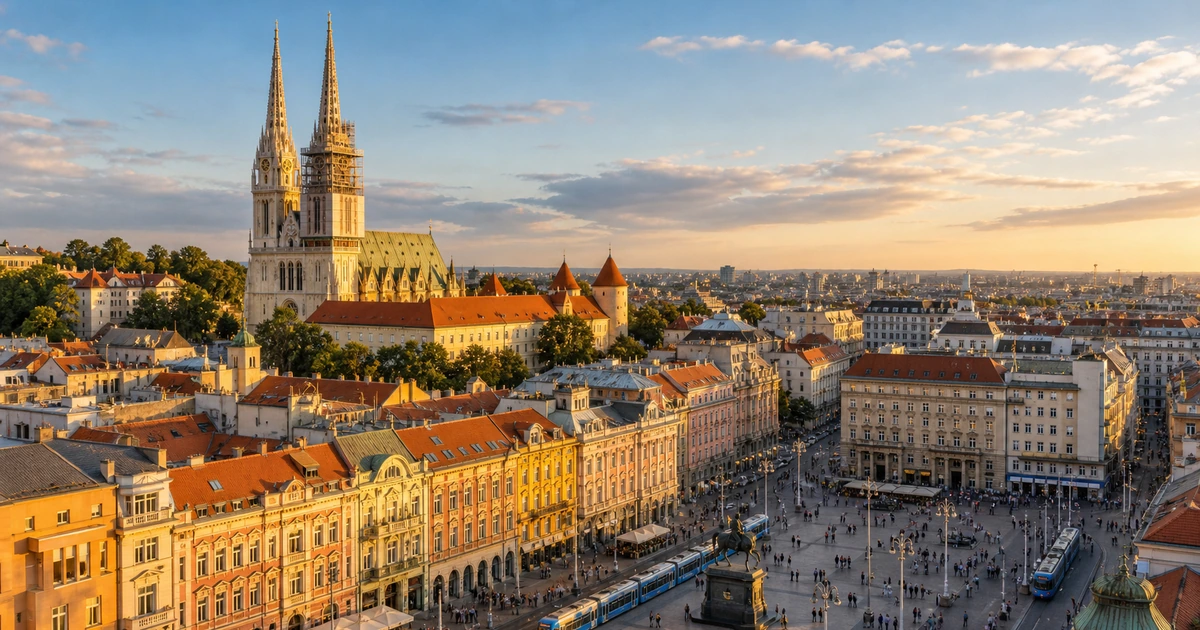
Zagreb
Local time--:--
Europe/ZagrebWeather Forecast
Zagreb, CroatiaOpen-Meteo forecast.
Zagreb city overview
Zagreb is Croatia's inland capital, a city of trams, cafe terraces and hilltop old-town streets. Start on Ban Jelacic Square, climb to Gradec and St. Mark's Church, then browse Dolac Market before an afternoon in Maksimir Park. Zagreb Airport is southeast of the city, with shuttle and taxi links to the centre.
Worth seeing
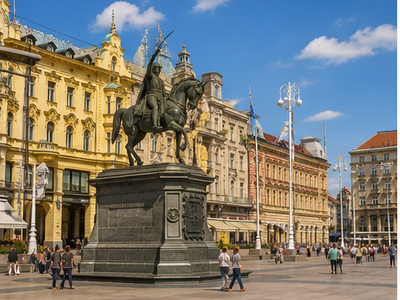
Ban Jelacic Square
Ban Jelacic Square is a clear heritage marker in Zagreb, best used as a fixed point when grouping nearby streets, monuments and viewpoints.
View on map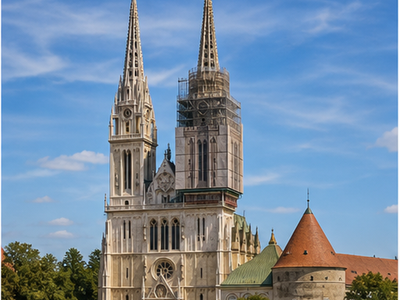
Gradec
Gradec is a named stop in Zagreb worth keeping on the route when it fits the day's transport, timing and neighborhood plan.
View on map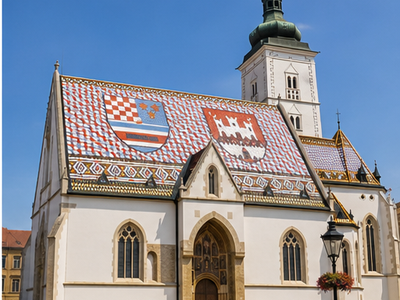
St. Mark's Church
St. Mark's Church is one of Zagreb's religious landmarks; check visiting hours and dress expectations before building the route around it.
View on map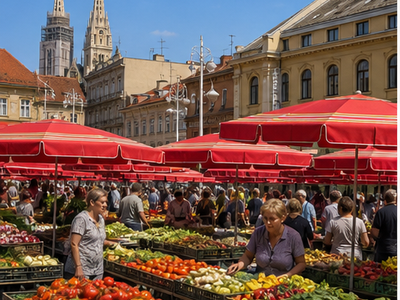
Dolac Market
Dolac Market gives Zagreb a concrete street-life stop, with food, everyday shopping and local movement that helps visitors read the city.
View on map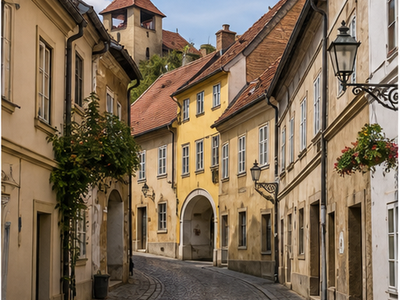
Maksimir Park
Maksimir Park gives Zagreb a greener or more scenic stop, useful when the route needs views, shade, walking space or a slower hour.
View on map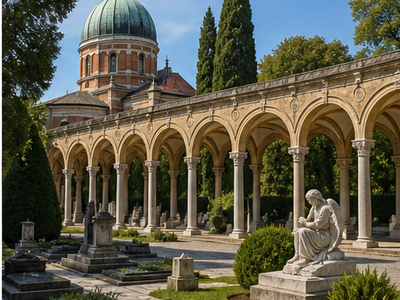
Museum of Broken Relationships
Museum of Broken Relationships gives Zagreb a strong culture stop for museums, exhibitions or local collections, and works best as an indoor anchor in the day's route.
View on mapStay overview
Lower Town is the easiest base for a first Zagreb stay, Upper Town is more atmospheric, British Square works for quieter cafe-led visits, and Maksimir suits families or longer stays near green space.
Hotels & areas
Zagreb's centre is compact and tram-friendly. Lower Town gives the best balance of hotels and transport, while Upper Town and British Square are better for charm if luggage and slopes are manageable.
Lower Town
Lower Town is the best first base, close to parks, museums, tram lines, shops and Ban Jelacic Square.
Best for: first visits, museums, tramsSee hotel optionsUpper Town
Upper Town is atmospheric and historic, with smaller stays near St. Mark's Church and viewpoint lanes.
Best for: history, views, atmosphereSee hotel optionsBritish Square
British Square is a quieter residential base with cafes, markets and easy tram access into the centre.
Best for: cafes, local stays, quiet nightsSee hotel optionsMaksimir
Maksimir suits park access, the zoo and calmer apartment stays east of the central core.
Best for: families, parks, apartmentsSee hotel optionsFlights & airports
Zagreb Franjo Tuđman International Airport (ZAG) arrival plan
- Zagreb Franjo Tuđman International Airport (ZAG)About 11 km from the centre
Compare airport access against hotel location, arrival time, rental car pickup, late flights and onward driving before choosing the first night base.
Rental cars
Zagreb day-trip car use
Do not rent for Zagreb itself; pick up a car when leaving for Plitvice, Istria or the coast.
Compare rental carsTravel tips
Best base
Stay in Lower Town for the simplest mix of hotels, trams, museums and restaurants within walking distance.
Markets
Visit Dolac Market in the morning, when produce, flowers and local shopping are at their liveliest.
Transit
Trams are useful and frequent, but many central sights are close enough to link on foot.
Day trip
Plitvice Lakes is possible as a long day trip, though an overnight nearby gives a better visit.
Nearby ideas
Nature · about 1 h 15 min · car or coach south on the A1 motorway
Plitvice Lakes National Park
Sixteen terraced lakes linked by waterfalls, crossed on wooden walkways and an electric boat.
View on mapTown · about 40 min · bus from Zagreb's main bus station
Samobor
A baroque market town known for its custard slice and a February carnival.
View on mapMountain · about 35 min · tram 14 to Mihaljevac then bus 140 to Sljeme
Medvednica Nature Park
The mountain over the city, with the Veternica cave and a medieval mining tunnel.
View on mapTown · about 1 h 15 min · train or bus north from Zagreb
Varaždin
Croatia's baroque capital for a decade, with a white fortress and a cemetery laid out as a garden.
View on mapCity history
The first recorded appearance of the name "Zagreb" dates from 1094, at which time the city existed as two different city centres: the smaller, eastern Kaptol, inhabited mainly by clergy and housing Zagreb Cathedral.
Zagreb became the Croatian capital in 1557, with city also being chosen as the seat of the Ban of Croatia in 1621 under ban Nikola IX Frankopan.
In 1669, they founded an academy where philosophy, theology, and law were taught, the forerunner of today's University of Zagreb.
In 1776, the royal council (government) moved from Varaždin to Zagreb and during the reign of the Emperor Joseph II Zagreb became the headquarters of the Varaždin and Karlovac general command. 19th to mid-20th.
In 1850, Gradec and Kaptol, with surrounding settlements, were united into a single settlement, today's city of Zagreb. 16th to 18th centuries There were numerous connections between the Kaptol diocese and the free sovereign.
The first railway line to connect Zagreb with Zidani Most and Sisak opened in 1862 and in 1863 Zagreb received a gasworks.
Since 1 January 1877, the Grič cannon fires daily from the Lotrščak Tower on Grič to mark midday.
After the 1880 Zagreb earthquake, up to the 1914 outbreak of World War I, development flourished and the town received the characteristic layout which it has today.
During World War II, Zagreb became the capital of the Independent State of Croatia (1941–1945), which was backed by Nazi Germany and by the Italians.
After Croatia declared independence from Yugoslavia in 1991, the Parliament of the Republic of Croatia proclaimed Zagreb as the capital of the Republic of Croatia. Early Zagreb The history of Zagreb dates as far.
Alongside the bishop's see, the canonical settlement Kaptol developed north of Zagreb Cathedral, as did the fortified settlement Gradec on the neighbouring hill, with the border between the two formed by the Medveščak stream.
After the war, working-class districts such as Trnje emerged between the railway and the Sava, whereas the construction of residential districts on the hills of the southern slopes of Medvednica was completed between the.
The history of Zagreb in World War II became rife with incidents of régime terror and resistance sabotage - the Ustaša régime had thousands of people executed during the war in and near the.
The cargo railway hub and the international airport (Pleso) were built south of the Sava river.