Forecast
Montevideo
Local time--:--
America/MontevideoWeather Forecast
Montevideo, UruguayOpen-Meteo forecast.
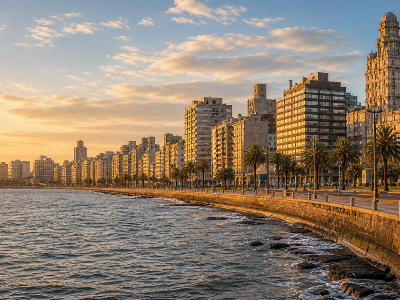
Montevideo city overview
Montevideo is Uruguay's calm coastal capital, built around the Rambla, old port streets, football culture and relaxed neighborhoods facing the Rio de la Plata. Start in Ciudad Vieja, eat at Mercado del Puerto, then follow the Rambla of Montevideo toward Pocitos Beach. Carrasco airport is straightforward, and the city works well before or after Colonia and Punta del Este.
Worth seeing
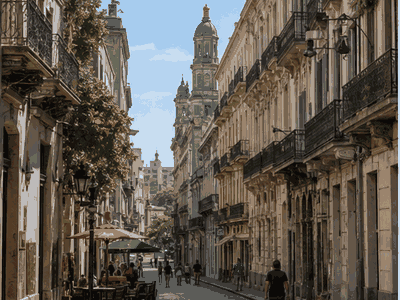
Ciudad Vieja
Ciudad Vieja is a named Montevideo landmark that helps structure a real visit, adding orientation, local context and a clear route anchor.
View on map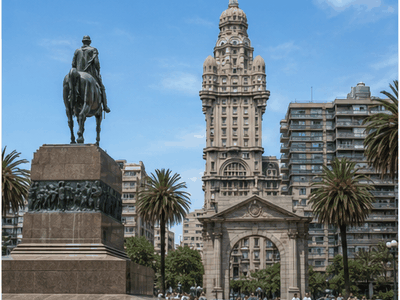
Mercado del Puerto
Mercado del Puerto is a named Montevideo landmark that helps structure a real visit, adding orientation, local context and a clear route anchor.
View on map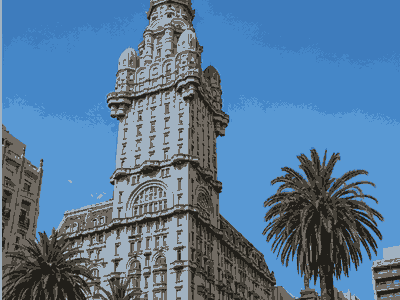
Rambla of Montevideo
Rambla of Montevideo is a named Montevideo landmark that helps structure a real visit, adding orientation, local context and a clear route anchor.
View on map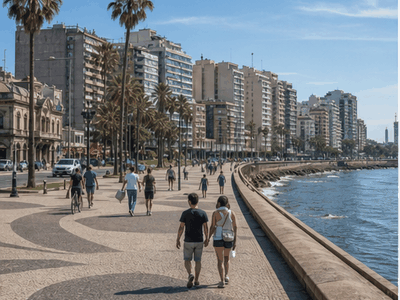
Plaza Independencia
Plaza Independencia is a named Montevideo landmark that helps structure a real visit, adding orientation, local context and a clear route anchor.
View on map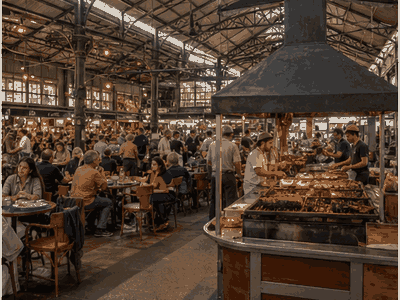
Teatro Solis
Teatro Solis is a named Montevideo landmark that helps structure a real visit, adding orientation, local context and a clear route anchor.
View on map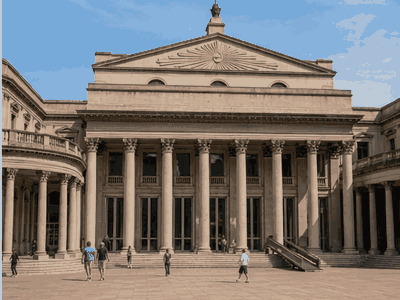
Pocitos Beach
Pocitos Beach adds outdoor time to a Montevideo stay, with open space, views or waterfront breathing room between denser city sights.
View on mapStay overview
Pocitos is the easiest first Montevideo base for beach walks, restaurants and safer evenings, while Punta Carretas is polished and walkable. Ciudad Vieja and Centro suit history and value, and Carrasco works for quiet airport-side stays.
Hotels & areas
Montevideo hotel choice is pleasantly simple: use Pocitos or Punta Carretas for most leisure stays, Ciudad Vieja for history, Centro for value and theatres, or Carrasco when airport access and quiet beach streets matter.
Ciudad Vieja
Ciudad Vieja is best for history, port restaurants, museums and daytime walking, though nights are quieter outside key streets.
Best for: history, markets, short staysSee hotel optionsCentro
Centro is practical for Avenida 18 de Julio, theatres, transport and better value than the waterfront neighborhoods.
Best for: value, theatres, transitSee hotel optionsPocitos
Pocitos is the easiest first base for beach walks, restaurants, safer evenings and modern apartment-style stays.
Best for: first visits, beach, restaurantsSee hotel optionsPunta Carretas
Punta Carretas is upscale and walkable, with malls, dining, Rambla access and a quieter feel than Centro.
Best for: upscale stays, dining, RamblaSee hotel optionsCarrasco
Carrasco is elegant and residential, close to the airport and beach but farther from old-city sights.
Best for: airport access, quiet stays, beachSee hotel optionsFlights & airports
Carrasco General Cesáreo L. Berisso International Airport (MVD) arrival plan
- Carrasco General Cesáreo L. Berisso International Airport (MVD)About 17 km from the centre
Compare airport access against hotel location, arrival time, rental car pickup, late flights and onward driving before choosing the first night base.
- Capitan Corbeta CA Curbelo International Airport (PDP)About 100 km from the centre
Compare airport access against hotel location, arrival time, rental car pickup, late flights and onward driving before choosing the first night base.
Rental cars
Montevideo day-trip car use
A rental car is unnecessary inside Montevideo, but useful for Punta del Este, wineries or coastal road trips.
Compare rental carsTravel tips
Best base
Choose Pocitos or Punta Carretas for a first stay because the Rambla, restaurants and evening walks are easy.
Rambla time
Keep the Montevideo plan compact: group nearby sights together and leave enough time for transfers, meals and weather changes.
Weekend pace
Ciudad Vieja can be quiet on weekends and evenings, so check restaurant hours before planning dinner there.
Day trips
Colonia is easy by bus or car, while Punta del Este needs a longer beach-focused day or overnight.
Nearby ideas
Heritage · about 1 h 15 min · coach west on Route 1 from Tres Cruces
Colonia del Sacramento
A Portuguese smuggling port of cobbled streets, with a lighthouse built into convent ruins.
View on mapBeach · about 1 h 15 min · coach east on Route Interbalnearia
Piriápolis
Uruguay's first resort, laid out in the 1890s under a hill with a chairlift to the top.
View on mapWine · about 40 min · car north on Route 5 towards Las Piedras
Canelones wine route
Family bodegas pouring tannat, the grape Uruguay has made its own.
View on mapUpcoming events
No upcoming Montevideo events in the shared event index yet.
City history
Between 1680 and 1683, Portugal founded the city of Colonia do Sacramento in the region across the bay from Buenos Aires.
On 22 November 1723, Field Marshal Manuel de Freitas da Fonseca of Portugal built the Montevieu fort.
On 22 January 1724, the Spanish forced the Portuguese to abandon the location and started populating the city, initially with six families moving in from Buenos Aires and soon thereafter by families arriving from.
Until the end of the 18th century, Montevideo remained a fortified area, today known as Ciudad Vieja. 19th century On 3 February 1807, British troops under the command of General Samuel Auchmuty and Admiral.
During the May Revolution of 1810 and the subsequent uprising of the provinces of Rio de la Plata, the Spanish colonial government moved to Montevideo.
In 1816, Portugal invaded the recently liberated territory and in 1821, it was annexed to the Banda Oriental of Brazil.
Juan Antonio Lavalleja and his band called the Treinta y Tres Orientales ("Thirty-Three Orientals") re-established the independence of the region in 1825.
Uruguay was consolidated as an independent state in 1828, with Montevideo as the nation's capital.
In 1829, the demolition of the city's fortifications began and plans were made for an extension beyond the Ciudad Vieja, referred to as the "Ciudad Nueva" ("new city").
When the Portuguese invaded the Banda Oriental and annexed it as the province of Cisplatina until 1831, they called the city Montevidéu, and pronounced as .
In 1838, Oribe was forced to resign from the presidency; he established a rebel army and began a long civil war, the Guerra Grande, which lasted until 1851.
In 1853 a stagecoach bus line was established joining Montevideo with the newly formed settlement of Unión and the first natural gas street lights were inaugurated.
This theory is supported by numerous maps and documents from the colonial period that refer to the Cerro de Montevideo with the name Monte Vídeo.
In that decade the city expanded quickly: new neighborhoods were created and many separate settlements were annexed to the city, among which were the Villa del Cerro, Pocitos, the Prado and Villa Colón.