Forecast
Quito
Local time--:--
America/GuayaquilWeather Forecast
Quito, EcuadorOpen-Meteo forecast.
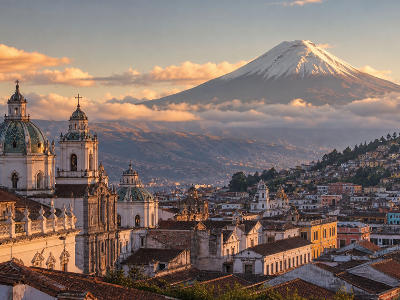
Quito city overview
Quito stretches along an Andean valley under the Pichincha volcano, with one of South America's finest colonial centres and quick access to mountain viewpoints. Start in Quito Old Town, climb or taxi to El Panecillo, then ride TeleferiQo if the weather is clear. Mariscal Sucre airport is far outside the city, so transfer timing should shape your first and last night.
Worth seeing
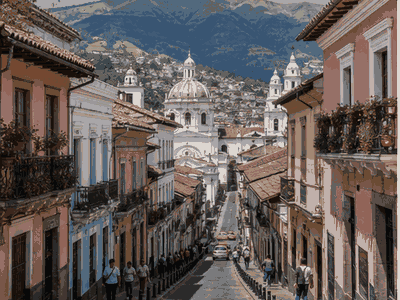
Quito Old Town
Quito Old Town is a named Quito landmark that helps structure a real visit, adding orientation, local context and a clear route anchor.
View on map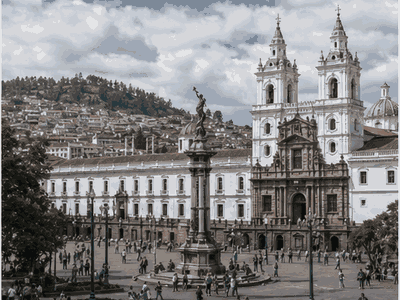
Basilica del Voto Nacional
Basilica del Voto Nacional anchors the historic and ceremonial side of Quito, making it a practical stop for architecture, local memory and orientation.
View on map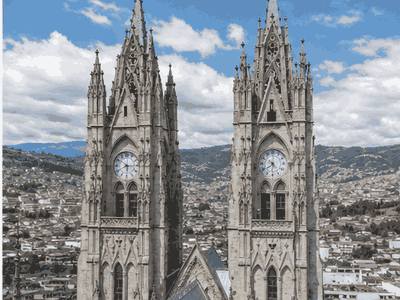
TeleferiQo
TeleferiQo is a named Quito landmark that helps structure a real visit, adding orientation, local context and a clear route anchor.
View on map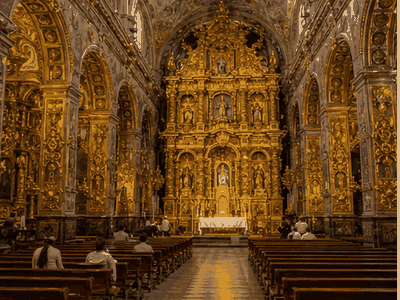
Mitad del Mundo
Mitad del Mundo is a named Quito landmark that helps structure a real visit, adding orientation, local context and a clear route anchor.
View on map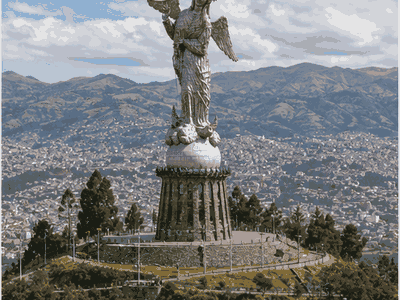
La Compania de Jesus
La Compania de Jesus is famous for its lavish gold interior, one of the old town's essential church stops.
View on map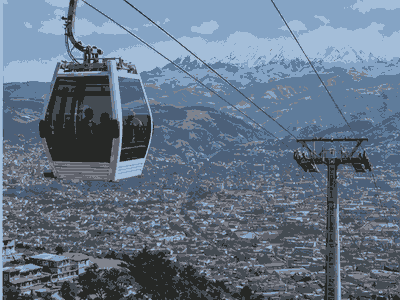
El Panecillo
El Panecillo is the hilltop statue viewpoint above the old town, best reached by taxi rather than walking.
View on mapStay overview
Centro Historico is the best base for Quito's churches and plazas, while La Mariscal is easier for nightlife and tours. La Floresta suits cafes, La Carolina works for business, and Guapulo is scenic but less walkable.
Hotels & areas
Quito hotel choice should account for altitude and transfers: Centro Historico is atmospheric, La Mariscal is practical, La Floresta is calmer and food-focused, La Carolina is modern, and Guapulo is scenic with taxi dependence.
Centro Historico
Centro Historico is best for churches, plazas and museums, though evenings are quieter and taxis are sensible after dark.
Best for: history, churches, short staysSee hotel optionsLa Mariscal
La Mariscal has hotels, hostels, restaurants and nightlife, useful for social stays and tour pickups.
Best for: nightlife, hostels, toursSee hotel optionsLa Floresta
La Floresta is a creative dining and cafe district, calmer than La Mariscal and good for longer stays.
Best for: cafes, dining, longer staysSee hotel optionsLa Carolina
La Carolina works for business hotels, shopping, park access and a more modern north-city base.
Best for: business, shopping, parksSee hotel optionsGuapulo
Guapulo is scenic and hillside, best for boutique stays with taxis rather than heavy walking at altitude.
Best for: views, boutique stays, quiet nightsSee hotel optionsFlights & airports
Mariscal Sucre International Airport (UIO) arrival plan
- Mariscal Sucre International Airport (UIO)About 22 km from the centre
Compare airport access against hotel location, arrival time, rental car pickup, late flights and onward driving before choosing the first night base.
- Cotopaxi International Airport (LTX)About 76 km from the centre
Compare airport access against hotel location, arrival time, rental car pickup, late flights and onward driving before choosing the first night base.
Rental cars
Quito day-trip car use
Do not rent for central Quito; consider a car or driver only for onward highland, Cotopaxi or cloud-forest routes.
Compare rental carsTravel tips
Altitude
Quito is very high, so avoid overpacking the first day and take TeleferiQo only if you feel well.
Airport timing
Book early flights carefully because Mariscal Sucre is far from the city and morning transfers start before dawn.
Best base
Choose Centro Historico for culture, La Floresta for cafes, or La Carolina for a modern and practical stay.
Weather
Viewpoints are best in clear morning windows; clouds can close in quickly around Pichincha and the old town.
Nearby ideas
Craft · about 1 h 15 min · coach from Carcelén terminal north
Otavalo market
An indigenous textile market that has run on Saturdays since before the Inca arrived.
View on mapMountain · about 1 h 15 min · car south on the Panamericana to the park gate
Cotopaxi National Park
A snow cone rising to 5,897 metres, with Limpiopungo lagoon on the plain below it.
View on mapCity history
The city was later refounded at its present location on 6 December 1534 by 204 settlers led by Sebastián de Benalcázar, who captured leader Rumiñahui, effectively ending all organized resistance.
The second important vestige of human settlement was found in the current neighborhood of Cotocollao (1500 BC), northwest of Quito.
The conquistador Diego de Almagro founded Santiago de Quito (in present-day Colta, near Riobamba) on 15 August 1534, renamed as San Francisco de Quito on 28 August 1534.
In January 1535 the San Francisco Convent was constructed, the first of about 20 churches and convents built during the colonial period.
In 1563 Quito became the seat of a Real Audiencia (administrative district) of Spain.
Quito briefly proclaimed its de facto independence from Spain between 1765 and 1766 during the Quito Revolt.
On 10 August 1809, a movement was again started in Quito to win independence from Spain.
This initial movement was defeated on 2 August 1810, when colonial troops arrived from Lima, Peru, and killed the leaders of the uprising and about 200 other settlers.
Their victory established the independence of Quito and the surrounding areas. Republican Period In 1833, members of the Society of Free Inhabitants of Quito were assassinated by the government after they conspired against it.
On 9 July 1883, the liberal commander Eloy Alfaro participated in the Battle of Guayaquil, and after further conflict he became the president of Ecuador on 4 September 1895.
In 2010, the Museo de Sitio La Florida opened to preserve some of the artifacts from the tombs and explain this complex culture.
The new Mariscal Sucre International Airport, a 45-minute drive from central Quito, opened to air traffic on 20 February 2013.
A new subway system opened with one line on 1 December 2023.
The first church (El Belén) was built before the city was officially founded.