Forecast
Medellin
Local time--:--
America/BogotaWeather Forecast
Medellin, ColombiaOpen-Meteo forecast.
Medellin city overview
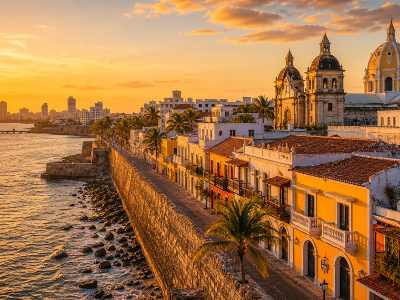
Medellin fills a green Andean valley with springlike weather, public transit landmarks and a confident food-and-nightlife scene. Start in El Poblado or Laureles, ride the Metrocable toward Parque Arvi, and visit Comuna 13 for murals and hillside history. Jose Maria Cordova airport sits outside the valley, so transfer timing matters more than distance on the map.
Worth seeing
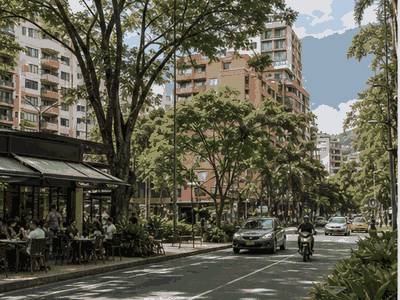
Comuna 13
Comuna 13 is known for murals, outdoor escalators and neighborhood history, best visited with a responsible local guide.
View on map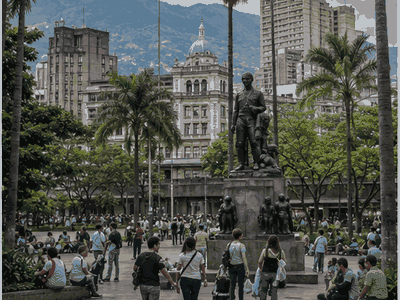
Plaza Botero
Plaza Botero is a named Medellin landmark that helps structure a real visit, adding orientation, local context and a clear route anchor.
View on map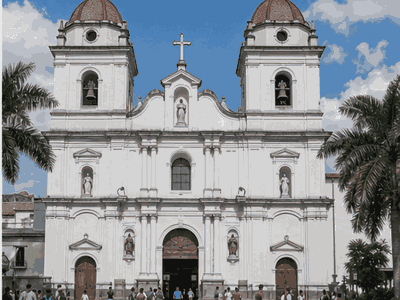
Museum of Antioquia
Museum of Antioquia is a key Medellin culture stop, useful for understanding local history, collections and rainy-day planning near the main sightseeing route.
View on map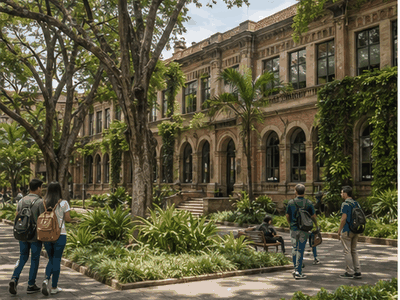
Parque Arvi
Parque Arvi is a named Medellin landmark that helps structure a real visit, adding orientation, local context and a clear route anchor.
View on map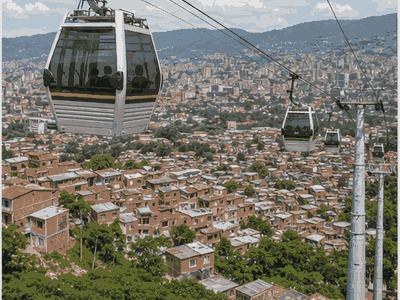
Metrocable
Metrocable is a named Medellin landmark that helps structure a real visit, adding orientation, local context and a clear route anchor.
View on map
Jardin Botanico
Jardin Botanico is a calm botanical garden near Universidad station, useful for a slower morning in the city.
View on mapStay overview
El Poblado is the simplest first Medellin base for hotels, restaurants and airport transfers, while Laureles feels calmer and more local. Envigado suits longer stays, Ciudad del Rio is practical and modern, and Centro is mainly a daytime sightseeing area.
Hotels & areas
Medellin hotel choice is about evenings and valley logistics: El Poblado is convenient and international, Laureles is relaxed, Envigado is local, Ciudad del Rio is practical, and Centro is better visited than used as a first base.
El Poblado
El Poblado is the easiest first base, with hotels, restaurants, nightlife and strong taxi access to the airport road.
Best for: first visits, nightlife, restaurantsSee hotel optionsLaureles
Laureles is flatter and more residential, with cafes, local nightlife and a calmer feel than El Poblado.
Best for: longer stays, cafes, local feelSee hotel optionsEnvigado
Envigado is quieter and local, useful for longer stays with restaurants, metro access and a slower pace.
Best for: quiet stays, longer visits, restaurantsSee hotel optionsCiudad del Rio
Ciudad del Rio works for modern apartments, museums, offices and quick routes between El Poblado and the centre.
Best for: apartments, business, museumsSee hotel optionsCentro
Centro is best for daytime museums and Plaza Botero, but most visitors prefer to sleep in El Poblado or Laureles.
Best for: daytime sights, museums, budgetSee hotel optionsFlights & airports
Jose Maria Córdova International Airport (MDE) arrival plan
- Jose Maria Córdova International Airport (MDE)About 19 km from the centre
Compare airport access against hotel location, arrival time, rental car pickup, late flights and onward driving before choosing the first night base.
- Enrique Olaya Herrera Airport (EOH)About 4 km from the centre
Compare airport access against hotel location, arrival time, rental car pickup, late flights and onward driving before choosing the first night base.
Rental cars
Medellin day-trip car use
Skip a rental car in Medellin; metro, Metrocable, taxis and tours are easier for valley movement and hillside visits.
Compare rental carsTravel tips
Best base
Choose El Poblado for a first stay if nightlife, restaurants and straightforward airport transfers are priorities.
Airport timing
Jose Maria Cordova is outside the valley, so leave extra time for tunnels, rain and weekend traffic.
Transit
Use the Metro and Metrocable for orientation; they are part of the city's story, not only transport.
Day trips
Guatape is the classic full-day trip, but start early if you want both the rock and the town.
Nearby ideas
Nature · about 1 h 15 min · coach from Terminal del Norte
Guatapé and El Peñol
740 steps up a granite monolith over a flooded valley, beside a town of painted house friezes.
View on mapHeritage · about 1 h 15 min · coach west through the Túnel de Occidente
Santa Fe de Antioquia
The old colonial capital, whitewashed and hot, with a 1895 suspension bridge over the Cauca.
View on mapCity history
Three years later, the Spaniards started the construction of the Basilica of Our Lady of Candelaria, which was rebuilt at the end of the 18th century. Growth of the town After 1574, with Gaspar.
In 1616, the colonial visitor Francisco de Herrera y Campuzano founded a settlement with 80 Amerindians, naming it Poblado de San Lorenzo, now El Poblado.
In 1646, a colonial law on casta ordered the separation of Indigenous peoples (indios) from mestizos and mulattos.
In 1675, the first census during colonial times was taken: there were 3,000 people and 280 families.
In 1808, two years before Colombia won independence, the city had 15,347 people and 360 families.
In 1821 it was renamed Colegio de Antioquia, and it became the University of Antioquia in 1901.
The Antioquia Railway (built in 1875) conquered the difficult geography of one of the most mountainous regions of South America, notably with the La Quiebra Tunnel, which connected the industrial center to the Magdalena.
Medellín clubs, many of them dating to the end of the 19th century, became a center for intellectual and industrialist movements, like Club Union (founded in 1894) and Club Campestre (founded in 1924).
In 1932 Medellín also built its first airport, the Enrique Olaya Herrera Airport.
Savage on industrial production in Antioquia between 1960 and 1972 showed how important Medellín industries became to Colombia and South America.
Social exclusion has eased due to the development of a transport infrastructure; a new system of public buses called "Metroplus" opened in December 2011, and gondolas called "MetroCable", which help connect the poorest barrio.
The colonial administration began the construction of a new town in Aná, today Berrío Park, where the church of Nuestra Señora de la Candelaria de Aná ("Our Lady of Candelaria of Aná") was built.
The provincial capital, Santa Fe, started to lose importance and gradually became poor, as trade and prominent personalities of the region came to the Aburrá Valley, where rich families started to buy land.
The industrial and commercial dynamism of Medellín also created a caste of traders and entrepreneurs, who founded the first nationwide industries in Colombia. Trade in Medellín Coltejer is one of the most important textile.