Forecast
Madrid
Local time--:--
Europe/MadridWeather Forecast
Madrid, SpainOpen-Meteo forecast.
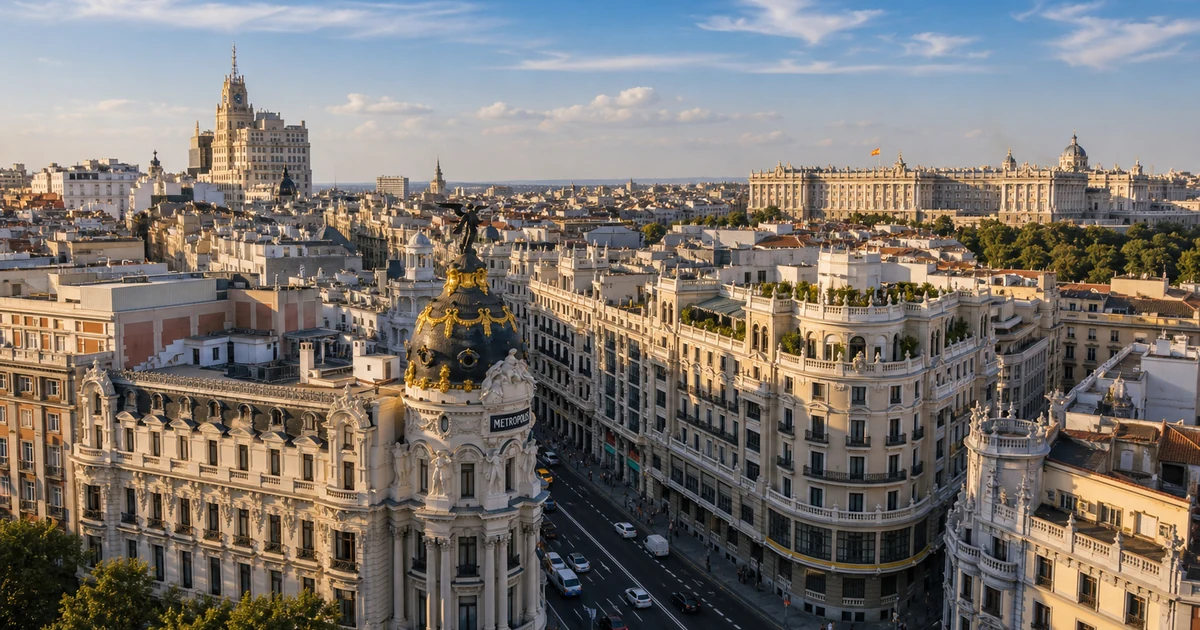
Madrid city overview
Madrid works best as a base in Spain when you anchor days around Prado Museum, Royal Palace of Madrid and Plaza Mayor Madrid. Use those sights to understand the city's history, street life and visitor rhythm. Madrid Barajas handles the main arrival flow, so hotel choice should balance the centre, transfer time and day-trip plans.

Worth seeing
Prado Museum
Prado Museum is a key Madrid culture stop, useful for understanding local history, collections and rainy-day planning near the main sightseeing route.
View on map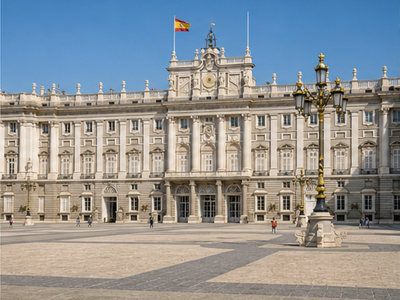
Royal Palace of Madrid
Royal Palace of Madrid anchors the historic and ceremonial side of Madrid, making it a practical stop for architecture, local memory and orientation.
View on map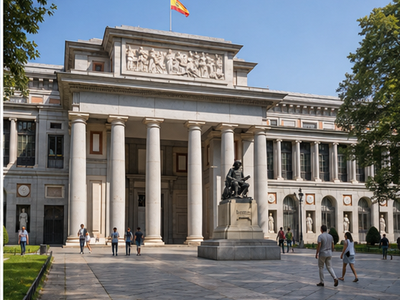
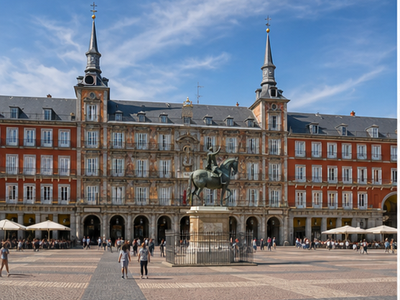
Plaza Mayor Madrid
Plaza Mayor Madrid is a clear heritage marker in Madrid, best used as a fixed point when grouping nearby streets, monuments and viewpoints.
View on map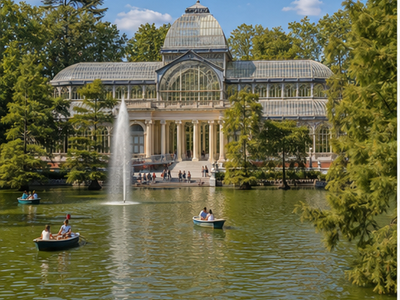
Retiro Park
Retiro Park adds outdoor time to a Madrid stay, with open space, views or waterfront breathing room between denser city sights.
View on map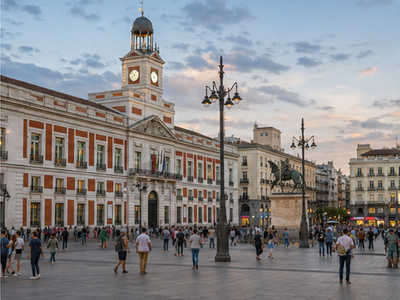
Puerta del Sol
Puerta del Sol is a named stop in Madrid worth keeping on the route when it fits the day's transport, timing and neighborhood plan.
View on map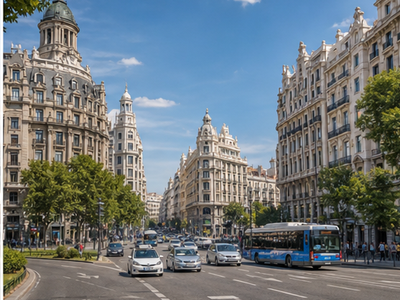
Gran Via Madrid
Gran Via Madrid is a named stop in Madrid worth keeping on the route when it fits the day's transport, timing and neighborhood plan.
View on mapStay overview
Start with Centro for the easiest first Madrid stay, then compare Malasana and Salamanca when price, nightlife, quieter evenings or transfer timing matter more than being beside every major sight.
Hotels & areas
Madrid hotel choice is mostly about repeat journeys: use Centro for sightseeing, Malasana for a different local base, and Salamanca or Retiro when views, parking, airport timing or longer stays matter.
Centro
Centro is the most practical first base in Madrid, keeping main sights, restaurants and short local transfers close.
Best for: first visits, sightseeing, restaurantsSee hotel optionsMalasana
Malasana is useful when a Madrid stay needs more local restaurants, apartment options or quieter nights outside the busiest core.
Best for: local stays, restaurants, quieter nightsSee hotel optionsSalamanca
Salamanca is useful when a Madrid stay needs more local restaurants, apartment options or quieter nights outside the busiest core.
Best for: local stays, restaurants, quieter nightsSee hotel optionsRetiro
Retiro is useful when a Madrid stay needs more local restaurants, apartment options or quieter nights outside the busiest core.
Best for: local stays, restaurants, quieter nightsSee hotel optionsFlights & airports
Adolfo Suárez Madrid–Barajas Airport (MAD) arrival plan
- Adolfo Suárez Madrid–Barajas Airport (MAD)About 14 km from the centre
To the centre: Metro line 8 to Nuevos Ministerios (cheapest); Cercanías C1 and buses also run, about 40 min (Metro ticket with airport supplement).
Public transport
- Metro (12 lines), EMT busesMetro 6 am–1:30 am daily; buses 6 am–11:30 pm, night 'búhos' after 11:30 pm
- TaxiOfficial white taxis with red stripe, Uber, Cabify, PideTaxi — 'Libre' sign and green roof light mean free; make sure the meter is started
Rental cars
Madrid day-trip car use
Do not rent a car for central Madrid unless parking and traffic are part of the plan; use one mainly for regional day trips.
Compare rental carsTravel tips
Best base
Choose Centro for a first stay because it keeps main sights, restaurants and practical local movement close.
Airport timing
Leave extra time for Madrid Barajas, especially for early flights, late arrivals, traffic or unfamiliar transfer routes.
Local movement
Plan each day in clusters around Prado Museum and Royal Palace of Madrid so transfers do not consume the best sightseeing hours.
Day trips
Keep one flexible slot for nearby routes from Madrid, checking weather, transport and opening hours before committing.
Nearby ideas
Heritage · about 35 min · Avant high-speed train from Atocha
Toledo
A walled city of Christian, Jewish and Muslim quarters above a river gorge, with El Greco's paintings in place.
View on mapHeritage · about 30 min · Avant train from Chamartín to Segovia-Guiomar
Segovia
A Roman aqueduct standing without mortar, and the castle that inspired Disney's silhouette.
View on mapHeritage · about 1 h · Cercanías C-3 or C-8 from Atocha
El Escorial
Philip II's granite monastery-palace, holding the royal tombs and a library of 40,000 volumes.
View on mapMountain · about 1 h · Cercanías C-8 to Cercedilla
Sierra de Guadarrama National Park
Granite peaks and pine forest an hour from the city, with the Siete Picos ridge walk.
View on mapCity history
Madrid, located near Alcalá (under Muslim control until 1118), remained a borderland for a while, suffering a number of razzias during the Almoravid period, and its walls were destroyed in 1110.
The 1123 Charter of Otorgamiento established the first explicit limits between Madrid and Segovia, namely the Puerto de El Berrueco and the Puerto de Lozoya.
In 1202, Alfonso VIII gave Madrid its first charter to regulate the municipal council, which was expanded in 1222 by Ferdinand III.
Thanks to this, Madrid became the political centre of the monarchy, being the capital of Spain except for a short period between 1601 and 1606, in which the Court was relocated to Valladolid, and.
The uprising led to a declaration of war calling all the Spaniards to fight against the French invaders. Capital of the Liberal State Madrid was invaded on 24 May 1823 by a French army—the.
In the second half of the 9th century, Umayyad Emir Muhammad I built a fortress on a headland near the river Manzanares as one of the many fortresses he ordered built on the border.
In the early 17th century, although Madrid recovered from the loss of its capital status, with the return of diplomats, lords and affluent people, as well as an entourage of noted writers and artists.
Seeking to take advantage of Madrid's location at the geographic centre of Spain, the 18th century saw a sustained effort to create a radial system of communications and transports for the country through public.
Unlike other European capitals, during the first half of the 19th century the only noticeable bourgeois elements in Madrid (that experienced a delay in its industrial development up to that point) were merchants.
Benefiting from increasing prosperity in the 1980s and 1990s, the capital city of Spain consolidated its position as an important economic, cultural, industrial, educational, and technological centre on the European continent.
The first historical document about the existence of an established settlement in Madrid dates from the Muslim age.
Philip V built the Royal Palace, the Royal Tapestry Factory and the main Royal Academies.
The reign of Charles III, who came to be known as "the best mayor of Madrid", saw an effort to turn the city into a true capital, with the construction of sewers, street lighting.
The introduction of railway transport greatly helped Madrid's economic prowess, and led to changes in consumption patterns, such as the substitution of salted fish for fresh fish from the Spanish coasts, and further strengthening.