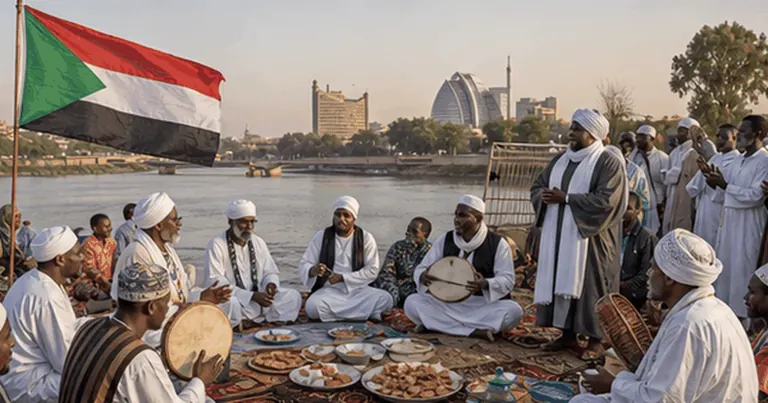
Sudan National Day 2027


More National days
National days topic
Return to the National days index for related events.
About the event
The day became Sudan's national celebration, but the country's later history has been marked by military rule, civil wars, the separation of South Sudan and recent conflict. The date made the new year a sovereignty anniversary for a country linking the Nile Valley, Sahel, Red Sea, Nubian history and many African and Arab identities.
Khartoum's Blue and White Nile meeting point is a powerful national image.
Why this day
1 January marks the day in 1956 when Sudan became independent from joint British-Egyptian rule. The date made the new year a sovereignty anniversary for a country linking the Nile Valley, Sahel, Red Sea, Nubian history and many African and Arab identities.
The day became Sudan's national celebration, but the country's later history has been marked by military rule, civil wars, the separation of South Sudan and recent conflict. Independence therefore carries both pride and a deep awareness of unresolved national questions.
Today observance depends heavily on political and security conditions, but the date is recognised through flags, official statements, music and family memory. Visitors trying to understand Sudan see the national story in Khartoum, Omdurman, Nile confluences, Sufi gatherings and Nubian heritage.
Across Sudanese communities, the day is often quieter than the history behind it. Tea, coffee, kisra, stews, poetry, music and family visits carry national feeling when formal public celebration is limited.
Timeline
- 1899Anglo-Egyptian Condominium begins over Sudan
- 1956Sudan becomes independent on New Year's Day
- 2011South Sudan separates after independence referendum
Key figures
Stay for the event
Check-in 31 Dec, check-out 2 Jan 2027 — 2 nights around 1 January 2027. Change the dates to stay longer.
AREA
Find stays in KhartoumGetting there
- Celebratednationwide
- CapitalKhartoum
- Time zoneCAT (UTC+2)
Host country
- Currency: Sudanese pound
- Language: Arabic, English
- Driving: on the right
- Capital: Khartoum
- Phone: +249
- Emergency: 999
- Electricity: 230 V, 50 Hz, plugs C/D/F/G
What to eat
Fava beans with oil, onion and chilli, a daily Sudanese staple.
Thin fermented sorghum flatbread served with stews.
Stew or sauce eaten with kisra, often made with meat or okra.
Thick porridge served with savoury sauces during gatherings.
Fava bean fritters similar to falafel, eaten as snacks or breakfast.
Flatbread served with meat stews and sauces.
What to drink
Strong sweet tea often flavoured with mint or spices.
Spiced coffee brewed in a clay pot, especially in eastern Sudan.
Deep red hibiscus drink served hot or cold.
Culture & traditions
Khartoum's Blue and White Nile meeting point is a powerful national image.
Omdurman gatherings use chanting, drums and movement in public devotion.
Meroe's pyramids recall ancient kingdoms along the Nile.
Poetry and song carry politics, love and memory in public culture.
Coming years
Sudan National Day 2028
- Saturday 1 January 2028Next event date
Sudan National Day 2029
- Monday 1 January 2029Event date
Sudan National Day 2030
- Tuesday 1 January 2030Event date