Slovenia Statehood Day 2027

More National days
National days topic
Return to the National days index for related events.
About the event
The Ten-Day War that followed was the shortest conflict of the Yugoslav Wars — the Yugoslav People's Army attempted to retake control, but Slovenia's Territorial Defence forces resisted effectively, and a ceasefire and withdrawal agreement was reached within ten days.
The iconic alpine lake with its island church and clifftop castle — Slovenia's most photographed landmark.
Why this day
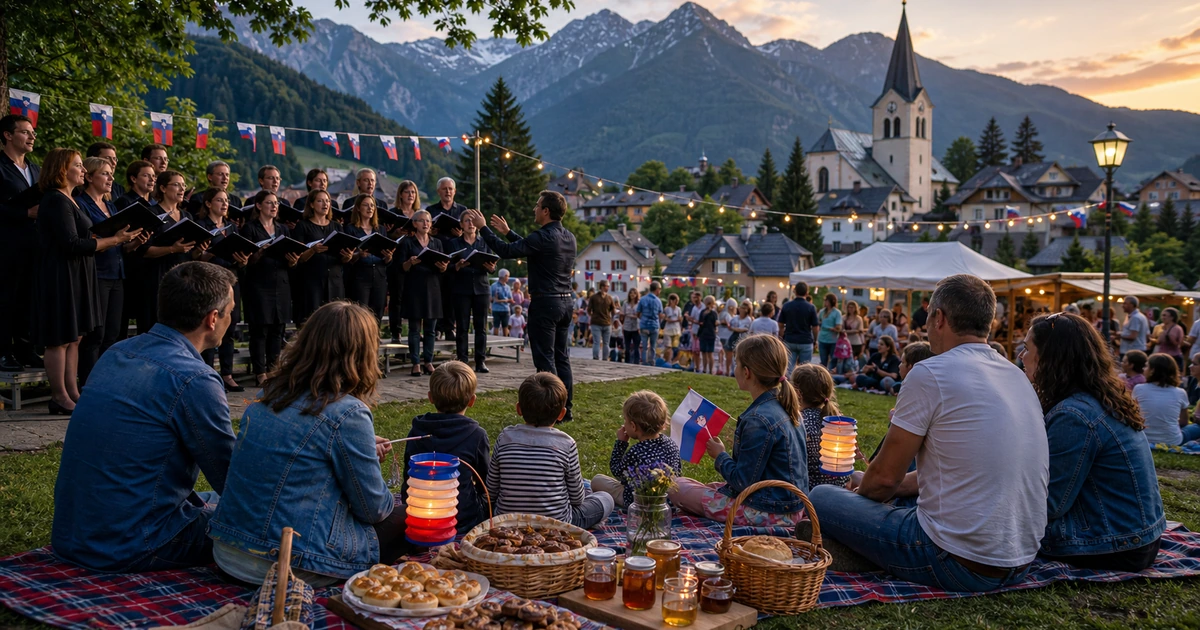
On 25 June 1991, the Slovenian parliament declared independence from Yugoslavia, along with Croatia on the same day. The Ten-Day War that followed was the shortest conflict of the Yugoslav Wars — the Yugoslav People's Army attempted to retake control, but Slovenia's Territorial Defence forces resisted effectively, and a ceasefire and withdrawal agreement was reached within ten days.
Slovenia had been the most economically developed and westward-looking of the Yugoslav republics. With a population that was predominantly Slovene and with limited ethnic minorities, independence was achieved with relatively little violence. Recognition by the European Community in January 1992 confirmed Slovenia's status and set it on a rapid path toward EU and NATO membership.
Statehood Day is celebrated with ceremonies at Kongresni trg in Ljubljana, a military ceremony and cultural events across the country. The Slovenian Alps, the Karst limestone plateau and the Adriatic coast give the celebration a backdrop of extraordinary natural beauty.
Timeline
- 1991Slovenia declares independence from Yugoslavia — Ten-Day War follows
- 2004Slovenia joins the European Union and NATO
- 2007Slovenia adopts the euro — first former Yugoslav state to do so
Stay for the event
Check-in 24 Jun, check-out 26 Jun 2027 — 2 nights around 25 June 2027. Change the dates to stay longer.
AREA
Find stays in LjubljanaGetting there
- Celebratednationwide
- CapitalLjubljana
- Time zoneCET (UTC+1)
Host country
- Currency: euro
- Language: Slovene
- Driving: on the right
- Capital: Ljubljana
- Phone: +386
- Emergency: 112
- Electricity: 230 V, 50 Hz, plugs C/F
What to eat
Smoked Carniolan sausage — the best-known Slovenian food product, with PGI protection since 2015.
Rolled nut cake with walnut, tarragon or poppy seed filling — the definitive Slovenian celebration cake.
Thick stew of sauerkraut, beans and smoked pork from the Karst region.
Rolled dumplings with cottage cheese, walnuts or tarragon — boiled or baked, a Slovenian classic.
Lake Bled cream cake — vanilla cream between crispy puff pastry layers, served at the lakeside hotel since 1953.
Multi-layer pastry with poppy seeds, cottage cheese, walnuts and apple — from the Pannonian plain.
What to drink
Kras Teran — deep red wine from the iron-rich Karst plateau limestone soil, unique to Slovenia.
Slovenian fruit brandy — pear, plum or apple varieties, home-distilled in mountain valleys.
Slovenia's two major lager brands — both well-made Central European pilsners.
Culture & traditions
The iconic alpine lake with its island church and clifftop castle — Slovenia's most photographed landmark.
UNESCO World Heritage underground canyon — one of the largest known underground chasms in the world.
Emerald-green alpine river — one of Europe's most beautiful, popular for kayaking and fly fishing.
Slovenia's only national park — centered on the 2864m peak that appears on the national flag.
Coming years
Slovenia Statehood Day 2028
- Sunday 25 June 2028Next event date
Slovenia Statehood Day 2029
- Monday 25 June 2029Event date
Slovenia Statehood Day 2030
- Tuesday 25 June 2030Event date