Senegal National Day 2027


More National days
National days topic
Return to the National days index for related events.
About the event
Families gather over thieboudienne, attaya tea, grilled fish and music, while Sufi brotherhoods, coastal life and neighbourhood pride shape the day beyond the formal parade. The day became central because it marks the legal break from French colonial rule and the beginning of Senegalese statehood under Léopold Sédar Senghor.
Dakar's Biennale (Dak'Art) — the most important contemporary art event in Africa, held every two years in the Senegalese capital.
Why this day
4 April marks the agreement in 1960 that transferred power from France to the Mali Federation, which included Senegal and French Sudan. Senegal later separated from the federation in August, but 4 April remains the national independence holiday.
The day became central because it marks the legal break from French colonial rule and the beginning of Senegalese statehood under Léopold Sédar Senghor. It also reflects Senegal's role as a cultural and political centre of Francophone West Africa.
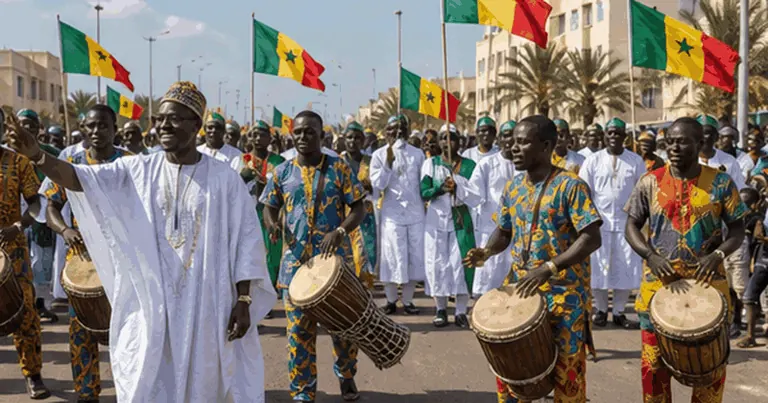
Today Independence Day is marked with a major military and civic parade in Dakar, official speeches, music and flags. Visitors see school groups, troops, sabar drums, elegant boubous and the green-yellow-red flag around the capital.
Across Senegal, the celebration is social and rhythmic. Families gather over thieboudienne, attaya tea, grilled fish and music, while Sufi brotherhoods, coastal life and neighbourhood pride shape the day beyond the formal parade.
Timeline
- 1895French West Africa administered from Dakar and Saint-Louis
- 1960Senegal signs transfer of power from France
- 1960Mali Federation dissolves and Senegal becomes fully separate
Key figures
Stay for the event
Check-in 3 Apr, check-out 5 Apr 2027 — 2 nights around 4 April 2027. Change the dates to stay longer.
AREA
Find stays in DakarGetting there
- Celebratednationwide
- CapitalDakar
- Time zoneGMT (UTC+0)
Host country
- Currency: West African CFA franc
- Language: French
- Driving: on the right
- Capital: Dakar
- Phone: +221
- Electricity: 230 V, 50 Hz, plugs C/D/E/K
What to eat
Senegal's national dish — broken rice cooked in a rich broth of fish, tomato and vegetables in a single pot, eaten communally.
Marinated grilled chicken with onion and lime — an everyday Senegalese dish served with broken rice and a spicy mustard sauce.
Lamb cooked with onion, tomato and mustard — a rich Senegalese celebration stew served with bread or rice.
Deep-fried black-eyed bean fritters made with onion and pepper — a popular Senegalese street breakfast and snack.
Peanut (groundnut) stew with meat or fish — a Senegalese classic eaten across the country with white rice.
Tamarind-thickened sauce with meat and vegetables — a sweet-sour Senegalese stew with pre-colonial roots.
What to drink
Senegal's celebrated hibiscus infusion — bright red, chilled with ginger and sugar, the most widely served drink at outdoor events.
Baobab fruit juice — milky, tangy and nutritious, from the iconic Sahelian tree that dots the Senegalese landscape.
Roasted dried corn drink — ground, brewed and served cold as a nutritious grain drink in northern Senegal.
Culture & traditions
Dakar's Biennale (Dak'Art) — the most important contemporary art event in Africa, held every two years in the Senegalese capital.
Lutte sénégalaise — traditional Senegalese wrestling with rituals, griots and enormous crowds; the country's most popular sport.
Sabar drumming and Mbalax music — the intensely rhythmic Wolof percussion tradition that gave rise to Youssou N'Dour's global sound.
Goree Island — UNESCO World Heritage site off Dakar's coast, a slave trade departure point, now a memorial and museum.
Coming years
Senegal National Day 2028
- Tuesday 4 April 2028Next event date
Senegal National Day 2029
- Wednesday 4 April 2029Event date
Senegal National Day 2030
- Thursday 4 April 2030Event date