Scotland National Day 2026


More National days
National days topic
Return to the National days index for related events.
About the event
In modern Scotland, the day has grown into a civic and cultural celebration, with events promoted across towns, museums and public spaces. The day is not a single independence anniversary, but a cultural marker built around Scotland's flag, music, food and public identity.
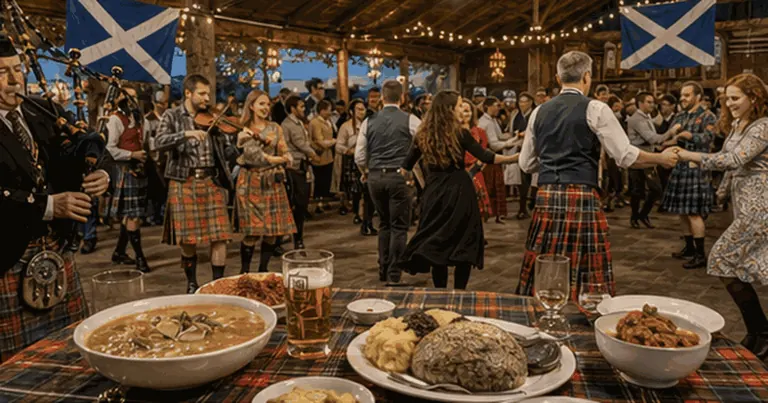
The holiday foregrounds the parts of Scottish culture visitors recognise immediately: music, dance, language and food.
Why this day
Scotland's national day is St Andrew's Day on 30 November, honouring the country's patron saint. The day is not a single independence anniversary, but a cultural marker built around Scotland's flag, music, food and public identity.
Saint Andrew's saltire became one of Scotland's strongest symbols over many centuries. In modern Scotland, the day has grown into a civic and cultural celebration, with events promoted across towns, museums and public spaces.
Today the day brings ceilidhs, pipe music, storytelling, food events and blue-and-white flags. Edinburgh and Glasgow host visible programmes, while smaller communities often mark it with school and local hall events.
Timeline
- 9th centurySaint Andrew became associated with Scotland
- 1320Declaration of Arbroath asserted Scottish sovereignty
- 2007St Andrew's Day became a bank holiday in Scotland
Key figures
Stay for the event
Check-in 29 Nov, check-out 1 Dec 2026 — 2 nights around 30 November 2026. Change the dates to stay longer.
AREA
Find stays in EdinburghGetting there
- Celebratednationwide
- CapitalEdinburgh
- Time zoneGMT (UTC+0)
Host country
- Currency: British pound
- Language: English, Scots, Scottish Gaelic
- Driving: on the left
- Capital: Edinburgh
- Phone: +44
- Emergency: 112
- Electricity: 230 V, 50 Hz, plugs G/D/M
What to eat
A savoury pudding of oats, spices and offal, usually with neeps and tatties
Smoked haddock, potato and onion soup
Scottish salmon served smoked or cooked
Buttery biscuit served with tea or whisky
Dessert with oats, raspberries, cream and whisky
Potato and meat dish common at gatherings
What to drink
Scotland's signature spirit, often part of tastings
Local beer served at pubs and ceilidhs
Served with baking at daytime events
Culture & traditions
Social dances with live bands and callers
Pipe music gives public events their ceremonial sound
Clan and regional patterns appear in dress and decoration
Blue-and-white flags are displayed on public buildings and in streets
Coming years
Scotland National Day 2027
- Tuesday 30 November 2027Next event date
Scotland National Day 2028
- Thursday 30 November 2028Event date
Scotland National Day 2029
- Friday 30 November 2029Event date