Republic Day of Turkey 2026


More National days
National days topic
Return to the National days index for related events.
About the event
Why Turkey celebrates 29 October On 29 October 1923, the Grand National Assembly of Turkey proclaimed the Republic of Turkey, ending the Ottoman Sultanate and establishing a modern, secular nation-state.
The greatest Byzantine church, later mosque, now again a mosque — the architectural marvel of Istanbul for 1500 years.
Why this day
On 29 October 1923, the Grand National Assembly of Turkey proclaimed the Republic of Turkey, ending the Ottoman Sultanate and establishing a modern, secular nation-state. Mustafa Kemal Atatürk became the first president. The date marks the most radical political transformation in Turkish history — a medieval empire reborn as a 20th-century republic.
Atatürk's reforms were sweeping and rapid. The caliphate was abolished, the Latin alphabet replaced Arabic script, Western dress codes were adopted, women gained the right to vote in 1934, and a secular civil code replaced Islamic sharia. Turkey was to be a European-style nation-state, and the republic's foundation on 29 October marked the start of that transformation.
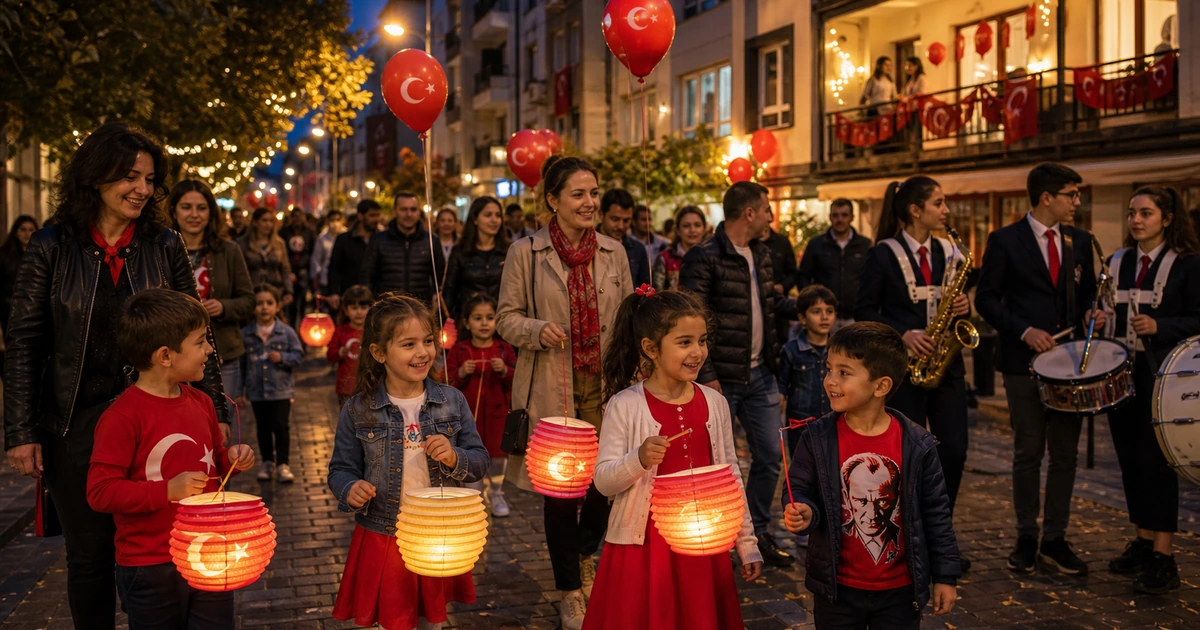
Republic Day is Turkey's most important national holiday. Ceremonies begin at 9:05 AM — the moment of Atatürk's death is commemorated each year on 10 November, but Republic Day itself begins with flag ceremonies and a minute of silence. Istanbul's Bosphorus is lit up, and major cities hold parades with red-and-white Turkish flags everywhere.
Timeline
- 1923Republic of Turkey proclaimed by Mustafa Kemal Atatürk
- 1934Women gain the right to vote — ahead of many Western countries
- 1938Atatürk dies — his legacy shapes Turkey to this day
Key figures
Stay for the event
Check-in 28 Oct, check-out 30 Oct 2026 — 2 nights around 29 October 2026. Change the dates to stay longer.
AREA
Find stays in IstanbulGetting there
- Celebratednationwide
- CapitalAnkara
- Time zoneTRT (UTC+3)
Host country
- Currency: Turkish lira
- Language: Turkish
- Driving: on the right
- Capital: Ankara
- Phone: +90
- Emergency: 112
- Electricity: 230 V, 50 Hz, plugs C/F
What to eat
Turkish kebab in its dozens of forms — Adana, shish, döner, İskender — is the foundation of Turkish grilled meat culture.
An array of small dishes — hummus, baba ghanoush, stuffed vine leaves, cacık, eggplant salads — served at the start of every meal.
Thin layers of yufka pastry filled with meat, cheese or spinach, baked or fried until golden.
Layers of filo with ground pistachios or walnuts soaked in sugar syrup — Gaziantep is the baklava capital.
Braised whole aubergine stuffed with onion, tomato and garlic — a vegetarian Ottoman classic.
Sesame-encrusted circular bread — sold on street carts across Turkey, eaten for breakfast.
What to drink
Anise-flavoured clear spirit — Turkey's national drink, drunk with water and ice alongside mezze.
Çay — strong black tea served in tulip-shaped glasses — consumed all day, every day, across Turkey.
Cold salted yogurt drink — the standard accompaniment to kebab and grilled meats.
Culture & traditions
The greatest Byzantine church, later mosque, now again a mosque — the architectural marvel of Istanbul for 1500 years.
The traditional steam bath — a social and cleansing ritual that has been part of Turkish culture since Ottoman times.
The Mevlevi Order's Sema ceremony in Konya — UNESCO-listed spinning meditation and musical performance.
Istanbul's covered market with 4000 shops — one of the oldest and largest in the world, active since 1461.
Coming years
Republic Day of Turkey 2027
- Friday 29 October 2027Next event date
Republic Day of Turkey 2028
- Sunday 29 October 2028Event date
Republic Day of Turkey 2029
- Monday 29 October 2029Event date