Madagascar National Day 2027


More National days
National days topic
Return to the National days index for related events.
About the event
The date restored sovereignty to an island with deep Austronesian, African, Arab and European connections, and a history shaped by the Merina kingdom before colonial rule. Antananarivo is the main stage, but the celebration reaches coastal towns, highland villages and diaspora communities with music, food and red-green-white colours.
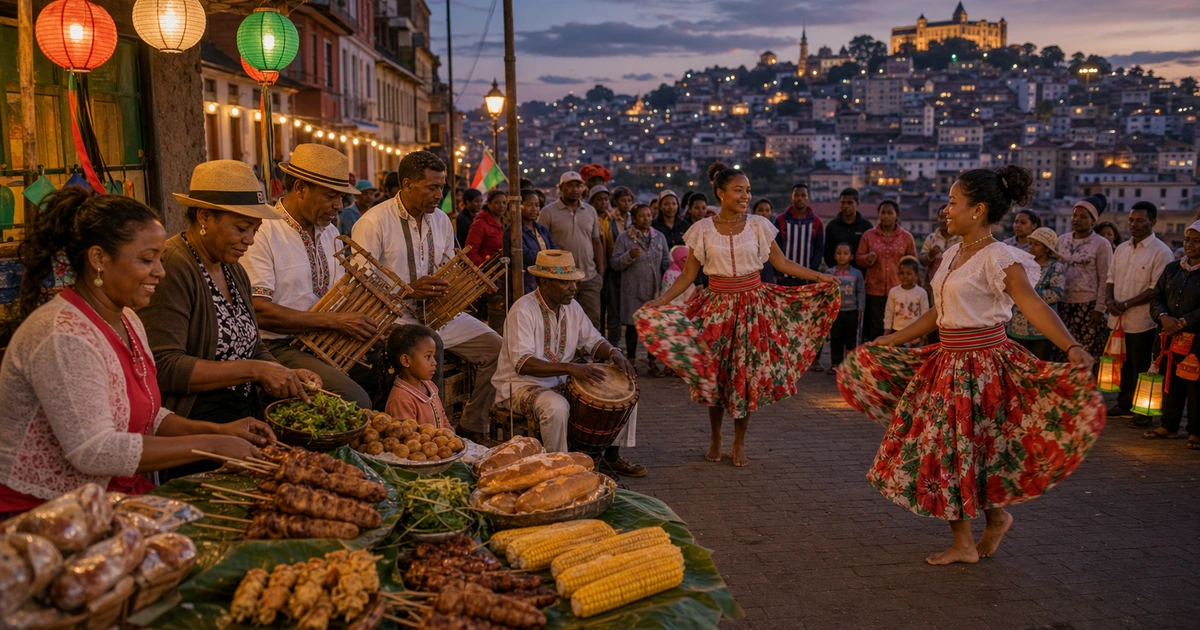
Children carry paper lanterns on the eve of Independence Day.
Why this day
26 June marks the day in 1960 when Madagascar regained independence from France. The date restored sovereignty to an island with deep Austronesian, African, Arab and European connections, and a history shaped by the Merina kingdom before colonial rule.
The day became the national celebration of a country whose identity is strongly island-based and highly regional. Independence is remembered alongside the 1947 Malagasy uprising, a violently suppressed revolt that remains one of the most important moments in anti-colonial memory.
Today Independence Day is marked with fireworks, flags, concerts, lanterns, speeches and family gatherings. Antananarivo is the main stage, but the celebration reaches coastal towns, highland villages and diaspora communities with music, food and red-green-white colours.
Across Madagascar, the night before the holiday is especially atmospheric. Children carry paper lanterns, streets fill with stalls, and families cook rice dishes, zebu, snacks and sweets while fireworks light the highland sky.
Timeline
- 1896Madagascar becomes a French colony after Merina rule
- 1960Madagascar regains independence from France
- 1972Popular protests force major political change
Key figures
Stay for the event
Check-in 25 Jun, check-out 27 Jun 2027 — 2 nights around 26 June 2027. Change the dates to stay longer.
AREA
Find stays in AntananarivoGetting there
- Celebratednationwide
- CapitalAntananarivo
- Time zoneEAT (UTC+3)
Host country
- Currency: Malagasy ariary
- Language: French, Malagasy
- Driving: on the right
- Capital: Antananarivo
- Phone: +261
- Emergency: 117
- Electricity: 220 V, 50 Hz, plugs C/E
What to eat
Beef and leafy green stew, often treated as Madagascar's national dish.
Crushed cassava leaves cooked with pork, garlic and sometimes coconut.
Chicken cooked with coconut milk and spices, common in coastal cooking.
Sweet rice flour cakes cooked in round moulds for breakfast or snacks.
Rice, peanut and banana cake wrapped in leaves and sliced.
Grilled zebu beef sold at markets, festivals and street stalls.
What to drink
Toasted rice water made from the browned crust in the cooking pot.
Madagascar's best-known lager, common at restaurants and gatherings.
Lychee aperitif reflecting one of Madagascar's major fruit crops.
Culture & traditions
Children carry paper lanterns on the eve of Independence Day.
Highland music-theatre combines song, dance, speech and colourful costume.
The royal hilltop complex symbolises Merina history and national memory.
Ancestral reburial ceremonies show the importance of kinship and memory.
Coming years
Madagascar National Day 2028
- Monday 26 June 2028Next event date
Madagascar National Day 2029
- Tuesday 26 June 2029Event date
Madagascar National Day 2030
- Wednesday 26 June 2030Event date