Ukraine Independence Day 2027


More National days
National days topic
Return to the National days index for related events.
About the event
The country celebrates its sovereignty while actively defending it — the day in 2022 and after was observed under wartime conditions, with the Ukrainian people demonstrating a determination that surprised the world.
The 11th-century Byzantine cathedral in Kyiv — a UNESCO World Heritage site and symbol of Ukrainian civilisation.
Why this day
On 24 August 1991, the Ukrainian parliament — the Verkhovna Rada — adopted the Act of Declaration of Independence of Ukraine, breaking away from the Soviet Union. The declaration followed the failed coup attempt against Mikhail Gorbachev and was confirmed by a referendum on 1 December 1991, in which over 90% of Ukrainians voted for independence.
Ukraine's path to sovereignty has been long and difficult. The country experienced independence briefly in 1917-1921 before being incorporated into the Soviet Union. During the Soviet period, Ukraine suffered the Holodomor — the artificial famine of 1932-1933 that killed between 3.5 and 7 million Ukrainians — and enormous losses in World War II. Independence in 1991 was therefore not just a political event but a release from decades of suppression.
Since Russia's full-scale invasion on 24 February 2022, Ukraine's Independence Day has taken on an even more profound significance. The country celebrates its sovereignty while actively defending it — the day in 2022 and after was observed under wartime conditions, with the Ukrainian people demonstrating a determination that surprised the world.
Timeline
- 882Kyiv established as capital of the Rus realm
- 1918Ukrainian People's Republic briefly independent before Soviet takeover
- 1991Ukraine declares independence from the Soviet Union
Key figures
Stay for the event
Check-in 23 Aug, check-out 25 Aug 2026 — 2 nights around 24 August 2026. Change the dates to stay longer.
AREA
Find stays in KyivGetting there
- Celebratednationwide
- CapitalKyiv
- Time zoneEET (UTC+2)
Host country
- Currency: Ukrainian hryvnia
- Language: Ukrainian
- Driving: on the right
- Capital: Kyiv
- Phone: +380
- Emergency: 112
- Electricity: 230 V, 50 Hz, plugs C/F
What to eat
Beet soup with beef, cabbage and sour cream — Ukraine's most iconic dish, declared an Intangible Cultural Heritage by UNESCO.
Boiled dumplings filled with potato and cheese, sauerkraut, cherries or meat — served with sour cream.
Potato pancakes with sour cream and mushroom sauce — hearty and satisfying.
Cabbage rolls stuffed with rice and minced pork in a light tomato sauce.
Soft garlic yeast rolls served alongside borscht — the classic bread accompaniment.
Cottage cheese pancakes — pan-fried and served with sour cream and jam for breakfast.
What to drink
Ukrainian grain spirit — similar to vodka but with a distinct character, often flavoured with herbs or pepper.
Dried fruit compote — made from prunes, apples and pears, served at Christmas and celebratory meals.
Fermented rye bread drink — slightly tangy, mildly alcoholic and sold from tanks in cities in summer.
Culture & traditions
The 11th-century Byzantine cathedral in Kyiv — a UNESCO World Heritage site and symbol of Ukrainian civilisation.
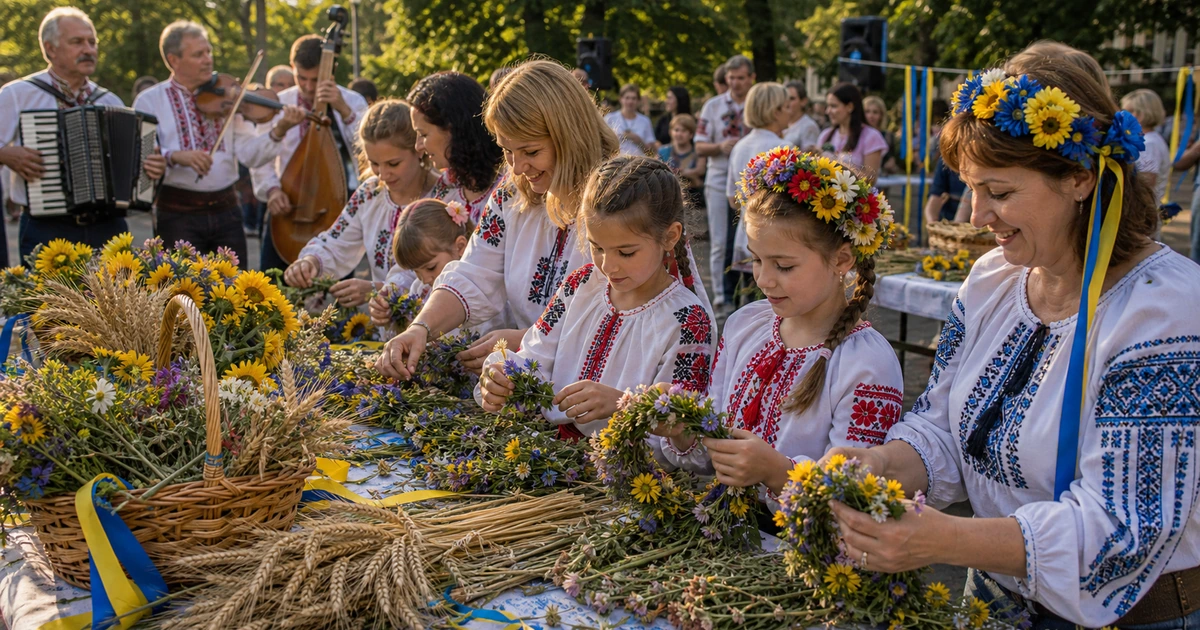
Intricate floral embroidery on white linen — worn as a symbol of national identity, especially on Independence Day.
The Monastery of the Caves — a UNESCO site with underground catacomb churches and Baroque bell towers.
Intricately decorated wax-resist eggs — a 5000-year-old Ukrainian art form with deep symbolic meaning.
Coming years
Ukraine Independence Day 2028
- Thursday 24 August 2028Next event date
Ukraine Independence Day 2029
- Friday 24 August 2029Event date
Ukraine Independence Day 2030
- Saturday 24 August 2030Event date