Swiss National Day 2027


More National days
National days topic
Return to the National days index for related events.
About the event
Why Switzerland celebrates 1 August Switzerland celebrates its National Day on 1 August — traditionally associated with the signing of the Federal Charter of 1291, in which the three original cantons of Uri, Schwyz and Unterwalden agreed to mutual defence and legal cooperation.
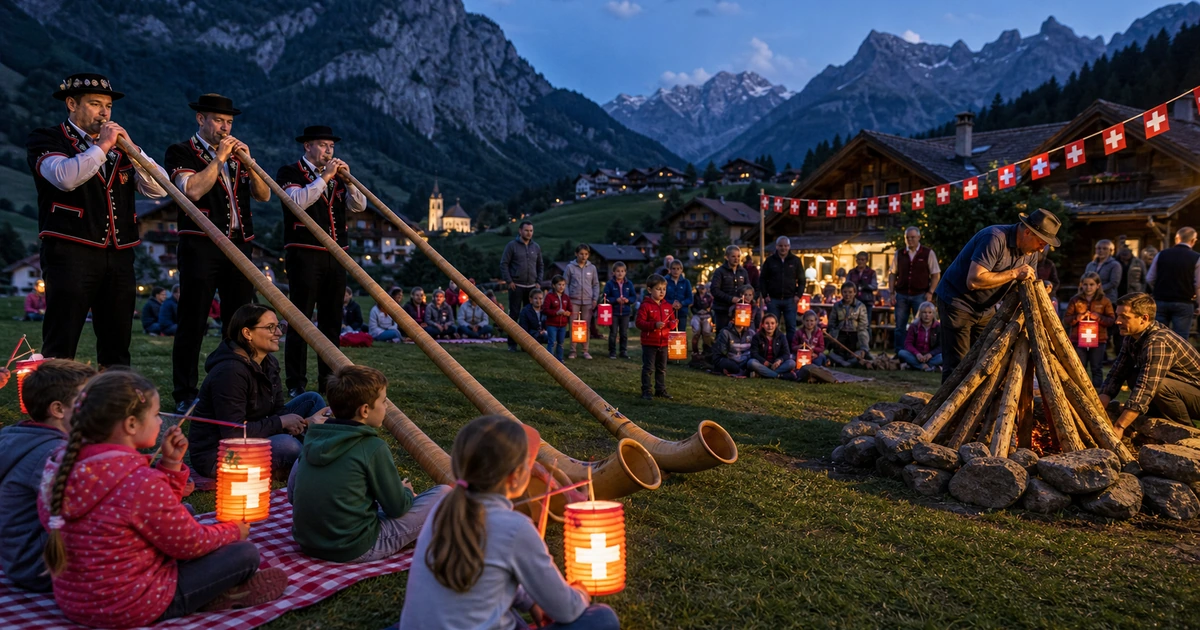
Fires lit on hilltops and lakeshores across Switzerland on the night of 1 August — a visual tradition centuries old.
Why this day
Switzerland celebrates its National Day on 1 August — traditionally associated with the signing of the Federal Charter of 1291, in which the three original cantons of Uri, Schwyz and Unterwalden agreed to mutual defence and legal cooperation. Though the document's exact significance has been debated by historians, 1 August 1291 was chosen as the symbolic founding date and has been the national holiday since 1891.
The Swiss Confederation grew gradually over the following centuries as more cantons joined. The modern federal state was established in 1848 with a constitution inspired by the American model — giving considerable autonomy to individual cantons while creating shared federal institutions. Switzerland has remained officially neutral in international conflicts since 1815.
Swiss National Day is celebrated with bonfires on hilltops and lakeshores across the country — a tradition going back centuries. Children carry lanterns, community bands play, fireworks reflect in the lakes, and citizens gather for speeches in town squares. The day has a distinctly local character — each commune celebrates in its own way.
Timeline
- 1291Federal Charter of 1291 — the founding document of the Swiss Confederation
- 1848Modern Switzerland established — federal constitution adopted
- 2002Switzerland joins the United Nations — last democracy to do so
Key figures
Stay for the event
Check-in 31 Jul, check-out 2 Aug 2027 — 2 nights around 1 August 2027. Change the dates to stay longer.
AREA
Find stays in ZurichGetting there
- Celebratednationwide
- CapitalBern
- Time zoneCET / CEST
Host country
- Currency: Swiss franc
- Language: German, French, Italian
- Driving: on the right
- Capital: Bern
- Phone: +41
- Emergency: 112
- Electricity: 230 V, 50 Hz, plugs C/J
What to eat
Melted Gruyère and Emmental cheese in a caquelon pot — bread cubes dipped in a communal vessel — the Swiss winter classic.
Wheel of Valais cheese melted and scraped onto boiled potatoes with cornichons and pickled onions.
Crispy grated potato cake — the national side dish of German Switzerland, made in countless regional variations.
Veal strips in a cream and mushroom sauce, served with rösti — Zurich's signature restaurant dish.
Yeast bread shaped as a man — baked on 6 December for St Nicholas Day but eaten at national celebrations too.
Alpine macaroni — pasta baked with cheese, cream and onion, served with apple sauce.
What to drink
Chasselas white wine from the Lake Geneva and Valais regions — largely consumed within Switzerland.
Uniquely Swiss whey-based soft drink — the country's favourite non-alcoholic drink.
Swiss cherry brandy from the orchards of Zug and Aargau — essential for fondue and Black Forest cake.
Culture & traditions
Fires lit on hilltops and lakeshores across Switzerland on the night of 1 August — a visual tradition centuries old.
Switzerland produces 90% of the world's mechanical watch movements — from Swatch to Rolex.
The Matterhorn, the Jungfraujoch and the valleys of the Valais — the Swiss Alps are among the world's most famous landscapes.
Basel's extraordinary three-day carnival — the largest in Switzerland, beginning before dawn each February.
Coming years
Swiss National Day 2028
- Tuesday 1 August 2028Next event date
Swiss National Day 2029
- Wednesday 1 August 2029Event date
Swiss National Day 2030
- Thursday 1 August 2030Event date