Sri Lanka National Day 2027


More National days
National days topic
Return to the National days index for related events.
About the event
The date restored self-government to an island with ancient kingdoms, Buddhist institutions, Tamil culture, colonial plantations and Indian Ocean trade history. Rice and curry, kiribath, tea, sweets, temple visits and beach outings connect the public anniversary to everyday island life.
The state ceremony includes military, cultural and school participation.
Why this day
4 February marks the day in 1948 when Ceylon, now Sri Lanka, became independent from Britain. The date restored self-government to an island with ancient kingdoms, Buddhist institutions, Tamil culture, colonial plantations and Indian Ocean trade history.
The day became the main national celebration, but Sri Lanka's story is marked by ethnic conflict, civil war and debates over language, religion and power. Independence is therefore celebrated alongside continuing questions about reconciliation and shared belonging.
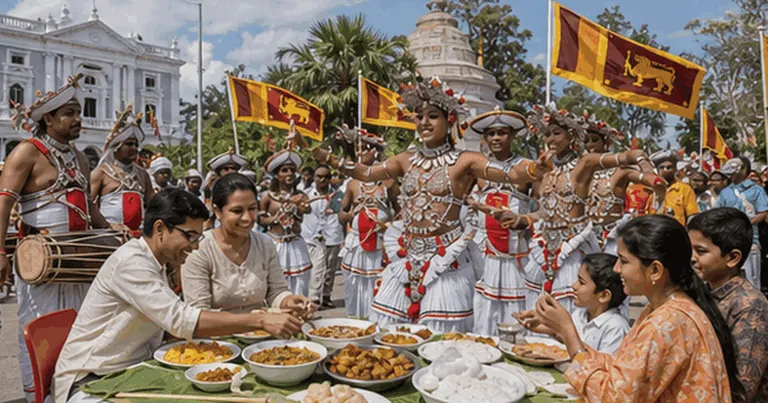
Today Independence Day is marked with a state ceremony, military parade, flag-raising, Buddhist, Hindu, Muslim and Christian observances, cultural performances and speeches. Visitors see lion flags, Kandyan dancers, drums, schoolchildren and formal ceremony in Colombo or a selected city.
Across Sri Lanka, the day is also family-based. Rice and curry, kiribath, tea, sweets, temple visits and beach outings connect the public anniversary to everyday island life.
Timeline
- 1815Kandyan Convention brings island under British rule
- 1948Ceylon gains independence from Britain
- 1972Republic of Sri Lanka declared with new constitution
Key figures
Stay for the event
Check-in 3 Feb, check-out 5 Feb 2027 — 2 nights around 4 February 2027. Change the dates to stay longer.
AREA
Find stays in ColomboGetting there
- Celebratednationwide
- CapitalSri Jayawardenepura Kotte
- Time zoneSLST (UTC+5:30)
Host country
- Currency: Sri Lankan rupee
- Language: Sinhala, Tamil
- Driving: on the left
- Capital: Sri Jayawardenepura Kotte
- Phone: +94
- Emergency: 110
- Electricity: 230 V, 50 Hz, plugs D/G/M
What to eat
Fermented rice bread steamed in a conical basket — Sri Lanka's most distinctive breakfast, eaten with coconut sambol and curry.
Shredded coconut mixed with dried chilli, Maldive fish and lime — the essential Sri Lankan condiment on every plate.
Slow-cooked Sri Lankan black curry with roasted spices and goraka — the darkest and most intense of the island's curries.
Rice flour hoppers (appam) — bowl-shaped crêpes cooked in a curved pan, eaten with coconut milk or egg in the centre.
Sri Lankan crab cooked in a rich tomato and chilli sauce — the prized seafood dish of Colombo's restaurants.
Sticky layered cake of cashew, pandan and semolina — the Sri Lankan celebration cake for every national occasion.
What to drink
Coconut water from the prolific King Coconut (thambili) — Sri Lanka's orange-husked native coconut, the island's most refreshing drink.
Ceylon black tea from the central highlands of Nuwara Eliya — among the world's finest teas, drunk with milk across the island.
King Coconut juice straight from the thambili — Sri Lanka's unique orange King Coconut is naturally sweet and higher in electrolytes.
Culture & traditions
The state ceremony includes military, cultural and school participation.
Drumming and dance bring highland ritual energy to public events.
Kandy's sacred Buddhist site is central to national heritage.
Cricket is one of the island's strongest shared popular passions.
Coming years
Sri Lanka National Day 2028
- Friday 4 February 2028Next event date
Sri Lanka National Day 2029
- Sunday 4 February 2029Event date
Sri Lanka National Day 2030
- Monday 4 February 2030Event date