Saudi Arabia National Day 2027


More National days
National days topic
Return to the National days index for related events.
About the event
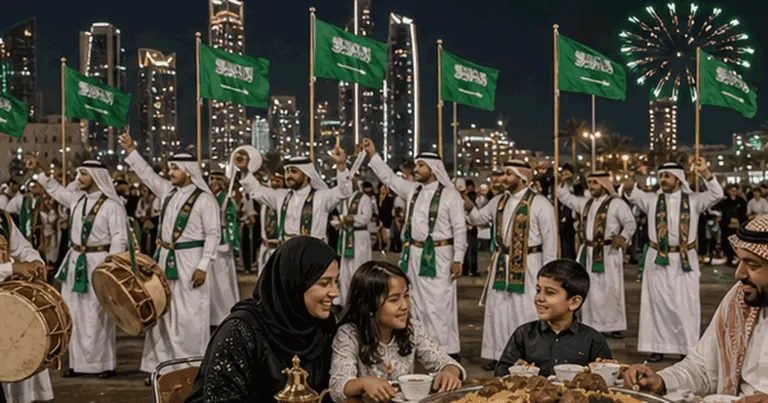
Across Saudi Arabia, the day blends state pride, family outings and heritage imagery: swords, palm trees, coffee, dates, kabsa, Ardah dance and green-and-white decorations all shape the public mood.
The Saudi National Day at-Taif roses festival and Jeddah Season — massive state-organised entertainment events with concerts, art and traditional performances.
Why this day
23 September marks the day in 1932 when Abdulaziz Ibn Saud unified his territories under the name Kingdom of Saudi Arabia. The date celebrates the creation of the modern Saudi state after decades of conquest, alliance-building and consolidation.
The day became the main national celebration in a country where public holidays were historically more religious than civic. In recent years it has grown much more visible, reflecting changing public culture, entertainment policy and national branding under Vision 2030.
Today National Day is marked with fireworks, concerts, air shows, green flags, public events and landmarks lit in Saudi colours. Visitors see a festive side of Riyadh, Jeddah and other cities, with families in malls, parks and promenades.
Across Saudi Arabia, the day blends state pride, family outings and heritage imagery: swords, palm trees, coffee, dates, kabsa, Ardah dance and green-and-white decorations all shape the public mood.
Timeline
- 1902Abdulaziz captures Riyadh and begins state-building campaign
- 1932Kingdom of Saudi Arabia officially unified and named
- 2016Vision 2030 launched to reshape society and economy
Key figures
Stay for the event
Check-in 22 Sep, check-out 24 Sep 2026 — 2 nights around 23 September 2026. Change the dates to stay longer.
AREA
Find stays in RiyadhGetting there
- Celebratednationwide
- CapitalRiyadh
- Time zoneAST (UTC+3)
Host country
- Currency: Saudi riyal
- Language: Arabic
- Driving: on the right
- Capital: Riyadh
- Phone: +966
- Emergency: 112
- Electricity: 230 V, 60 Hz, plugs G
What to eat
Saudi Arabia's national dish — whole lamb slow-cooked on saffron rice with almonds, raisins and cinnamon over a wood fire.
Slow-cooked lamb and fragrant rice with saffron and rosewater — the centrepiece of Saudi celebrations in Hijaz.
Bone-in lamb shoulder cooked with tomato and Hejazi spices — the traditional Saudi feast meat.
Whole wheat bread baked in a clay oven — unleavened, round and tear-apart, the everyday Saudi bread.
Slow-cooked brown beans with garlic and cumin — a Saudi breakfast staple dating back centuries.
Deep-fried dough balls soaked in date syrup or honey — sweet, sticky and eaten at festivals across Saudi Arabia.
What to drink
Green cardamom-spiced Arabic coffee — served from a long-spouted dallah pot in small handle-less cups, the cornerstone of Saudi hospitality.
Saudi date varieties — Medjool, Sukkari and Ajwa — eaten at every meeting with Arabic coffee as the national welcome.
Sweet rosewater and saffron cooling drink — traditionally served at celebrations and Ramadan iftars.
Culture & traditions
The Saudi National Day at-Taif roses festival and Jeddah Season — massive state-organised entertainment events with concerts, art and traditional performances.
Camel racing — a deeply embedded Saudi cultural tradition; pure-bred racing camels are worth millions and carry GPS jockeys at full speed.
Al-Balad historic Jeddah — a UNESCO coral and wood building quarter of the Red Sea merchant city, dating from the 7th century.
The Edge of the World (Jebel Fihrayn) — a dramatic escarpment overlooking the Tuwaiq plateau, one of Saudi Arabia's most spectacular landscapes.
Coming years
Saudi Arabia National Day 2028
- Saturday 23 September 2028Next event date
Saudi Arabia National Day 2029
- Sunday 23 September 2029Event date
Saudi Arabia National Day 2030
- Monday 23 September 2030Event date