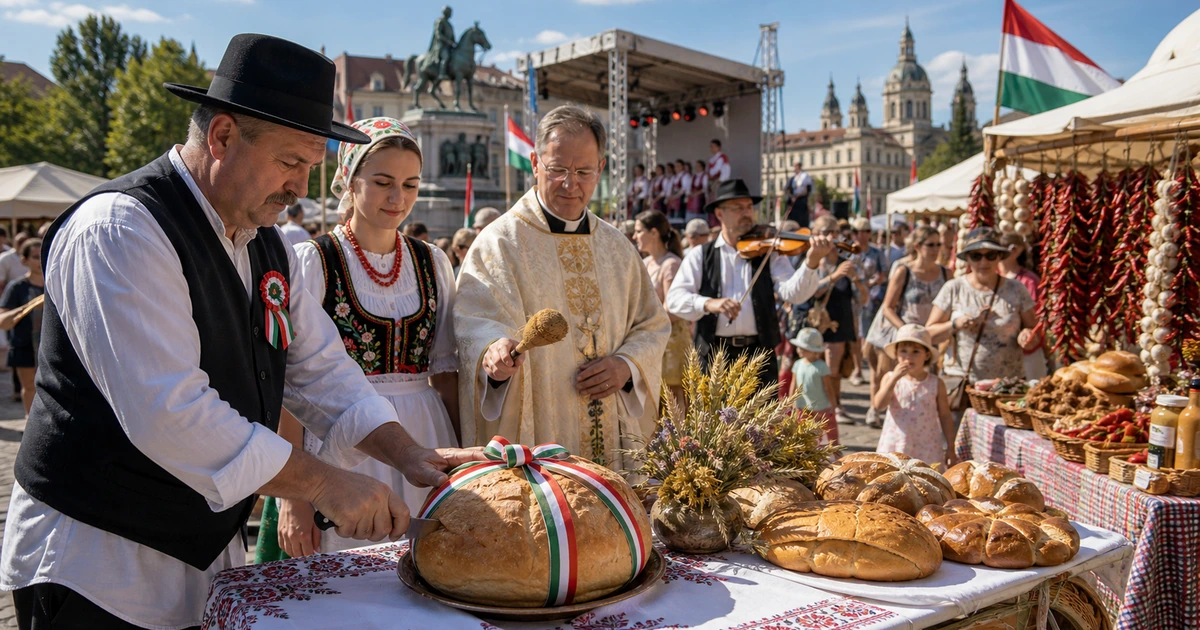
Saint Stephen's Day 2027


More National days
National days topic
Return to the National days index for related events.
About the event
Stephen was crowned on Christmas Day 1000 AD after receiving a crown from Pope Sylvester II, and he spent his reign Christianising Hungary, establishing its administrative structure and orienting it toward western Christendom.
Budapest sits on over 120 thermal springs — Széchenyi, Gellért and Rudas baths are architectural wonders.
Why this day
Hungary celebrates St Stephen's Day on 20 August — the feast day of King Stephen I, the founder of the Christian Kingdom of Hungary who was canonised in 1083. Stephen was crowned on Christmas Day 1000 AD after receiving a crown from Pope Sylvester II, and he spent his reign Christianising Hungary, establishing its administrative structure and orienting it toward western Christendom.
The date of 20 August is traditionally associated with Stephen's canonisation and with the translation of his remains to Buda. The Holy Crown of Hungary and his right hand — the "Holy Right" — are national relics of the greatest significance. The Holy Right procession through Budapest on 20 August is one of the most important Catholic ceremonies in Hungary.
St Stephen's Day coincides with the foundation of the Hungarian state and is the country's most important national holiday — more significant than the other national holidays of 15 March and 23 October. The celebrations include a massive fireworks display over the Danube River, the Bridge Festival, the Holy Right procession and the Budapest Formula 1 Grand Prix usually falls nearby.
Timeline
- 1000Stephen I crowned first King of Hungary — Hungary becomes a Christian kingdom
- 1241Mongol invasion devastates Hungary
- 1991Hungary becomes a republic after end of communist rule
Key figures
Stay for the event
Check-in 19 Aug, check-out 21 Aug 2026 — 2 nights around 20 August 2026. Change the dates to stay longer.
AREA
Find stays in BudapestHost country
- Currency: Hungarian forint
- Language: Hungarian
- Driving: on the right
- Capital: Budapest
- Phone: +36
- Emergency: 112
- Electricity: 230 V, 50 Hz, plugs C/F
What to eat
Rich beef and paprika soup-stew — cooked in a cauldron over open fire, the most iconic dish of Hungary.
Deep-fried dough topped with sour cream and grated cheese — the essential Hungarian street food.
Fisherman's hot paprika soup from the Danube and Tisza rivers — intensely spiced and flavourful.
Cabbage rolls stuffed with pork and rice in a tomato-sauerkraut sauce — a Hungarian celebration staple.
Chimney cake — dough wrapped around a spit, grilled until caramelised with sugar and walnuts.
Layered sponge cake with chocolate buttercream and a caramel top — Budapest's most celebrated cake.
What to drink
Hungary's legendary sweet wine from the Tokaj region — described by Louis XIV as "the wine of kings".
Hungarian fruit brandy — apricot, plum and pear varieties are the most beloved traditional spirits.
Bitter herbal digestif from the Zwack family — bitter, complex and drunk after a heavy Hungarian meal.
Culture & traditions
Budapest sits on over 120 thermal springs — Széchenyi, Gellért and Rudas baths are architectural wonders.
The 20 August fireworks display over the Danube is one of the largest in Europe — watched by over a million people.
The preserved right hand of Saint Stephen is carried through central Budapest in a solemn Catholic procession.
Hungary has produced two of classical music's giants — performed at concert halls in Budapest and worldwide.
Coming years
Saint Stephen's Day 2028
- Sunday 20 August 2028Next event date
Saint Stephen's Day 2029
- Monday 20 August 2029Event date
Saint Stephen's Day 2030
- Tuesday 20 August 2030Event date