Philippines National Day 2027


More National days
National days topic
Return to the National days index for related events.
About the event
Adobo, pancit, lechon, halo-halo, church visits, mall events and diaspora gatherings turn the national story into a broad social celebration. Choosing 12 June centres Filipino revolutionaries and the anti-colonial struggle rather than American recognition.
Philippine culture blends Austronesian, Spanish, American and regional influences, with Catholic festivals, pop music, family ties, overseas workers and food at the centre of public life.
Why this day
12 June marks the day in 1898 when Emilio Aguinaldo proclaimed Philippine independence from Spain in Kawit, Cavite. The declaration raised the Philippine flag and played the national anthem, creating the symbols still used today.
The day became the national independence holiday after being moved from 4 July, the date when the United States recognised independence in 1946. Choosing 12 June centres Filipino revolutionaries and the anti-colonial struggle rather than American recognition.
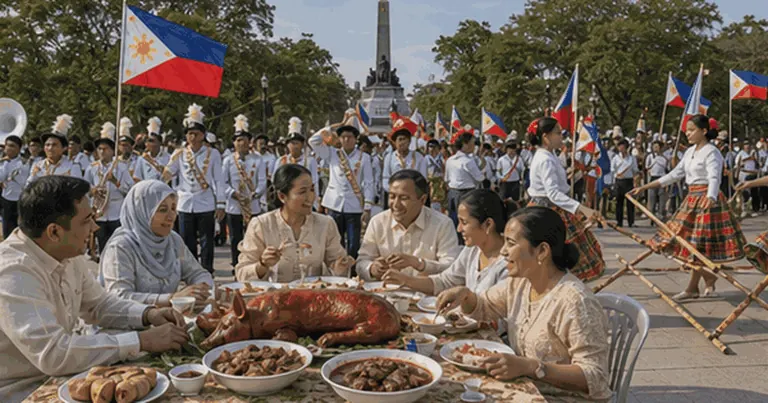
Today Independence Day is marked with flag-raising, wreath-laying, parades, speeches, cultural performances and ceremonies at historical sites such as Kawit and Rizal Park. Visitors see blue-red-white flags, school groups, brass bands and patriotic songs.
Across the Philippines, the day is family-oriented and festive. Adobo, pancit, lechon, halo-halo, church visits, mall events and diaspora gatherings turn the national story into a broad social celebration.
Timeline
- 1898Independence from Spain proclaimed in Kawit
- 1946United States recognises Philippine independence
- 1986People Power Revolution restores democratic institutions
Key figures
Stay for the event
Check-in 11 Jun, check-out 13 Jun 2027 — 2 nights around 12 June 2027. Change the dates to stay longer.
AREA
Find stays in ManilaGetting there
- Celebratednationwide
- CapitalManila
- Time zonePHT (UTC+8)
Host country
- Currency: Philippine peso
- Language: English, Filipino
- Driving: on the right
- Capital: Manila
- Phone: +63
- Emergency: 911
- Electricity: 230 V, 60 Hz, plugs A/B/C
What to eat
Pork slow-braised in soy sauce and cane vinegar with garlic and bay leaf — the Filipino national dish with Spanish-Chinese roots.
Slow-cooked pork knuckle (pig's leg) braised in soy sauce and star anise until tender and golden — the Filipino celebration dish.
Crispy roast pig — the gold standard of Filipino celebration food, served whole at fiestas with liver dipping sauce.
Pork or chicken stew in a sour tamarind broth with water spinach and eggplant — the Filipino comfort soup.
Grilled meat and seafood marinated in citrus and soy — served with spiced vinegar dipping sauce at every Filipino street celebration.
Bibingka rice cake cooked in a clay pot with banana leaf — the Filipino Christmas and celebration rice cake.
What to drink
Freshly tapped sap from the coconut palm — sweet and clear when fresh, slightly fizzy by afternoon. Ubiquitous in rural Philippines.
Philippine sugarcane spirit — clear and potent, the nation's most widely consumed spirit, drunk at every outdoor celebration.
Thick purple yam shake made with ube ice cream and milk — the most popular Filipino purple sweet potato drink.
Culture & traditions
Aguinaldo Shrine is a key site for Independence Day rites.
Manila's park hosts ceremonies honouring national hero Jose Rizal.
Bamboo pole dance is one of the best-known Filipino folk performances.
Filipino communities abroad mark the day with food, music and flags.
Coming years
Philippines National Day 2028
- Monday 12 June 2028Next event date
Philippines National Day 2029
- Tuesday 12 June 2029Event date
Philippines National Day 2030
- Wednesday 12 June 2030Event date