

About the event
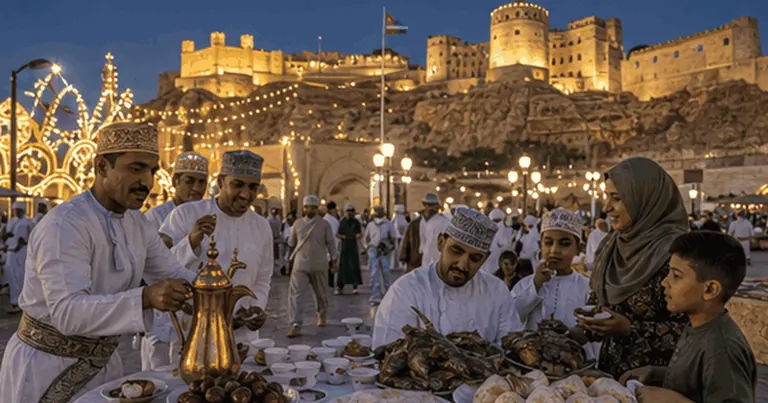
The day became Oman's main national celebration because Qaboos is associated with roads, schools, hospitals, diplomacy and national unity after isolation. People gather for shuwa, rice, dates, coffee and sweets, while wadis, mountains and old ports give the national story a strong sense of place.
The capital is decorated with flags, portraits and night lighting.
Why this day
18 November marks Oman National Day, the birthday of Sultan Qaboos bin Said, who took power in 1970 and reshaped the country. The date celebrates the modern Omani state more than a single independence moment.
The day became Oman's main national celebration because Qaboos is associated with roads, schools, hospitals, diplomacy and national unity after isolation. It also connects to older Omani maritime power, Ibadi tradition and the expulsion of the Portuguese from Muscat in 1650.
Today National Day is marked with lights, flags, official ceremonies, parades, fireworks, decorated cars and public displays across Muscat and other cities. Visitors see red-white-green flags, portraits of the sultan, forts, frankincense and a calm Gulf style.
Across Oman, the day is family-oriented and dignified. People gather for shuwa, rice, dates, coffee and sweets, while wadis, mountains and old ports give the national story a strong sense of place.
Timeline
- 1650Portuguese expelled from Muscat by Yaruba imams
- 1970Sultan Qaboos begins modern Omani state-building
- 2020Sultan Haitham succeeds Qaboos after five decades
Key figures
Stay for the event
Check-in 17 Nov, check-out 19 Nov 2026 — 2 nights around 18 November 2026. Change the dates to stay longer.
AREA
Find stays in MuscatGetting there
- Celebratednationwide
- CapitalMuscat
- Time zoneGST (UTC+4)
Host country
- Currency: Omani rial
- Language: Arabic
- Driving: on the right
- Capital: Muscat
- Phone: +968
- Emergency: 112
- Electricity: 240 V, 50 Hz, plugs G
What to eat
Spiced lamb slow-cooked underground, often prepared for major holidays.
Spiced rice with chicken, lamb or fish, common across Gulf tables.
Grilled kingfish served with lemon rice.
Wheat and meat porridge cooked until smooth for festive meals.
Sticky sweet with saffron, rosewater, nuts and cardamom.
Thin Omani flatbread served with honey, cheese or stews.
What to drink
Cardamom coffee served with dates as a welcome ritual.
Chilled yoghurt drink served with rice and grilled dishes.
Cold citrus and mint drink popular in warm weather.
Culture & traditions
The capital is decorated with flags, portraits and night lighting.
The curved dagger is worn ceremonially and appears on the national emblem.
Dhofar's frankincense trade links Oman to ancient commerce.
Wooden ships recall Oman's Indian Ocean trading history.
Coming years
Oman National Day 2027
- Thursday 18 November 2027Next event date
Oman National Day 2028
- Saturday 18 November 2028Event date
Oman National Day 2029
- Sunday 18 November 2029Event date