North Macedonia Independence Day 2027

More National days
National days topic
Return to the National days index for related events.
About the event
North Macedonia was known internationally as the Former Yugoslav Republic of Macedonia (FYROM) until 2019, when the Prespa Agreement with Greece resolved the issue and the country was renamed North Macedonia.
UNESCO World Heritage site on Lake Ohrid — 365 Orthodox churches and a 2000-year history of culture.
Why this day
On 8 September 1991, North Macedonia held an independence referendum in which over 95% of voters chose independence from Yugoslavia. The declaration was particularly peaceful — unlike the violent breakups in Croatia and Bosnia — and North Macedonia became the only Yugoslav republic to achieve independence without a war.
The country's post-independence path was complicated by the naming dispute with Greece, which objected to the use of "Macedonia" as implying territorial claims on the Greek region of the same name. North Macedonia was known internationally as the Former Yugoslav Republic of Macedonia (FYROM) until 2019, when the Prespa Agreement with Greece resolved the issue and the country was renamed North Macedonia.
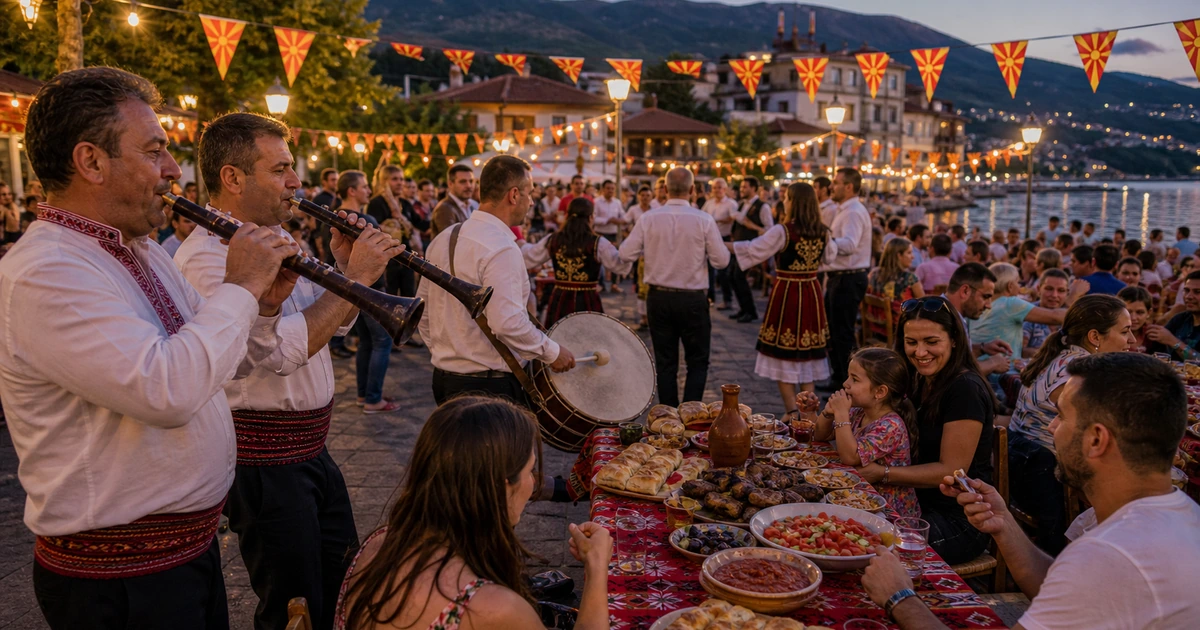
Independence Day is marked with a ceremony in Skopje's Macedonia Square, a military parade and cultural events. The day celebrates the peaceful achievement of sovereignty that was so elusive for the other Yugoslav states.
Timeline
- 1944Democratic Federal Macedonia proclaimed within Yugoslavia
- 1991Macedonian independence referendum — overwhelming vote for sovereignty
- 2019Country renamed North Macedonia after Prespa Agreement with Greece
Key figures
Stay for the event
Check-in 7 Sep, check-out 9 Sep 2026 — 2 nights around 8 September 2026. Change the dates to stay longer.
AREA
Find stays in SkopjeGetting there
- Celebratednationwide
- CapitalSkopje
- Time zoneCET (UTC+1)
Host country
- Currency: denar
- Language: Macedonian
- Driving: on the right
- Capital: Skopje
- Phone: +389
- Emergency: 112
- Electricity: 230 V, 50 Hz, plugs C/F
What to eat
Baked beans in a clay pot with dried peppers and onion — North Macedonia's most iconic dish.
Oval flatbread topped with cured lamb and fried eggs — a breakfast dish from Štip.
Mixed meat and vegetable casserole — beef, pork or lamb baked with okra and tomato in a clay pot.
Roasted red pepper and aubergine relish — made in autumn from the season's harvest, eaten all year.
Phyllo pastry filled with white cheese — the most popular morning snack at every Macedonian bakery.
Fried choux pastry soaked in sugar syrup — an Ottoman sweet eaten at celebrations.
What to drink
Anise-flavoured grape spirit — the signature local spirit of North Macedonia.
Award-winning wine from the Tikveš valley — Vranec red and Smederevka white are the leading varieties.
Fermented wheat drink — thick, mildly sweet and consumed at traditional shops and markets.
Culture & traditions
UNESCO World Heritage site on Lake Ohrid — 365 Orthodox churches and a 2000-year history of culture.
One of Europe's deepest and most ancient lakes — home to unique endemic species and crystal-clear water.
The old Ottoman bazaar in Skopje — the largest market in the Balkans, active for over 500 years.
Bronze Age astronomical observatory from 1800 BC — one of the oldest in the world.
Coming years
North Macedonia Independence Day 2028
- Friday 8 September 2028Next event date
North Macedonia Independence Day 2029
- Saturday 8 September 2029Event date
North Macedonia Independence Day 2030
- Sunday 8 September 2030Event date