Nigeria National Day 2027

More National days
National days topic
Return to the National days index for related events.
About the event
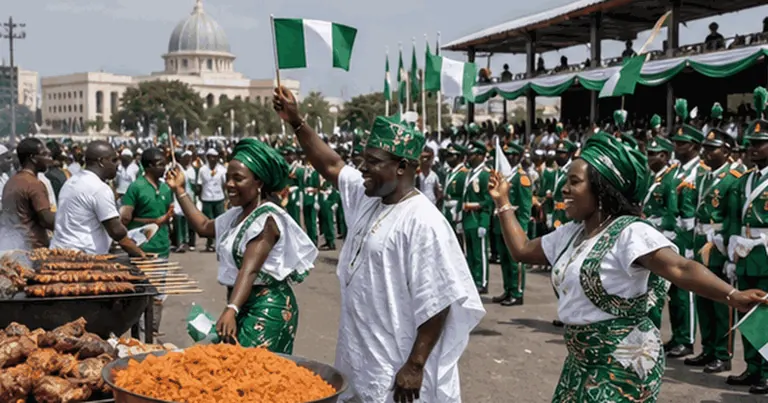
Across Nigeria, the day is loud, stylish and food-filled: jollof rice, suya, afrobeats, football, family visits and regional dress turn the public holiday into a celebration of scale and diversity.
The Argungu Fishing Festival in Kebbi State — men dive into a river and catch fish by hand in one of Africa's most unusual traditional competitions.
Why this day
1 October marks the day in 1960 when Nigeria became independent from Britain. The date created Africa's most populous country as a sovereign state, bringing together hundreds of ethnic groups, languages and regions within the borders shaped by colonial amalgamation.
The day became Nigeria's central national holiday because it carries the promise and difficulty of unity. Civil war, oil politics, military rule and democratic transitions all sit behind the green-white-green flag, making independence both a celebration and an unfinished national project.
Today Independence Day is marked with presidential speeches, flags, parades, concerts, church and mosque gatherings, and major media programming. Abuja is the formal centre, while Lagos supplies the pop-cultural energy that many visitors associate with modern Nigeria.
Across Nigeria, the day is loud, stylish and food-filled: jollof rice, suya, afrobeats, football, family visits and regional dress turn the public holiday into a celebration of scale and diversity.
Timeline
- 1914Northern and Southern protectorates amalgamated by Britain
- 1960Nigeria gains independence from Britain
- 1999Fourth Republic begins after military rule
Key figures
Stay for the event
Check-in 30 Sep, check-out 2 Oct 2026 — 2 nights around 1 October 2026. Change the dates to stay longer.
AREA
Find stays in AbujaGetting there
- Celebratednationwide
- CapitalAbuja
- Time zoneWAT (UTC+1)
Host country
- Currency: Nigerian naira
- Language: English
- Driving: on the right
- Capital: Abuja
- Phone: +234
- Emergency: 112
- Electricity: 230 V, 50 Hz, plugs D/G
What to eat
Slow-cooked stew of black-eyed beans ground into a paste, fried in palm oil with locust beans and crayfish — Nigeria's most widely eaten soup.
Slow-cooked Nigerian lamb or goat stew in a tomato and pepper base with curry and thyme — a staple at every national celebration.
Fermented locust bean condiment with a pungent umami smell — essential in Egusi and Ogbono soups across Nigeria.
Grilled beef suya skewers rubbed in a spice mix of groundnut, ginger and chilli — Nigeria's most famous street food.
Sweet balls of fried plantain — golden, soft and sold at roadside stalls and at every Nigerian outdoor celebration.
Steamed cornmeal dumpling wrapped in banana or maize leaf — eaten as a staple in the Middle Belt and north of Nigeria.
What to drink
Fresh sap tapped from the oil palm or raffia palm — sweet when just tapped, increasingly alcoholic as it ferments through the day.
Deep red hibiscus flower drink brewed with ginger and sweetened with sugar — served cold at Nigerian celebrations.
Malt-flavoured non-alcoholic soft drink — Nigeria's most widely consumed non-alcoholic beverage, drunk cold or warm.
Culture & traditions
The Argungu Fishing Festival in Kebbi State — men dive into a river and catch fish by hand in one of Africa's most unusual traditional competitions.
Lagos's vibrant Afrobeats, Highlife and Afropop scene — a music industry that has gone global with Burna Boy, Wizkid and Davido.
The world's largest film industry by volume — Nollywood produces thousands of films per year and exports across Africa and the diaspora.
The Benin Kingdom's bronze plaques and Yoruba Gelede masks — Nigeria holds some of the finest traditional art in the world.
Coming years
Nigeria National Day 2028
- Sunday 1 October 2028Next event date
Nigeria National Day 2029
- Monday 1 October 2029Event date
Nigeria National Day 2030
- Tuesday 1 October 2030Event date