Namibia National Day 2027

More National days
National days topic
Return to the National days index for related events.
About the event
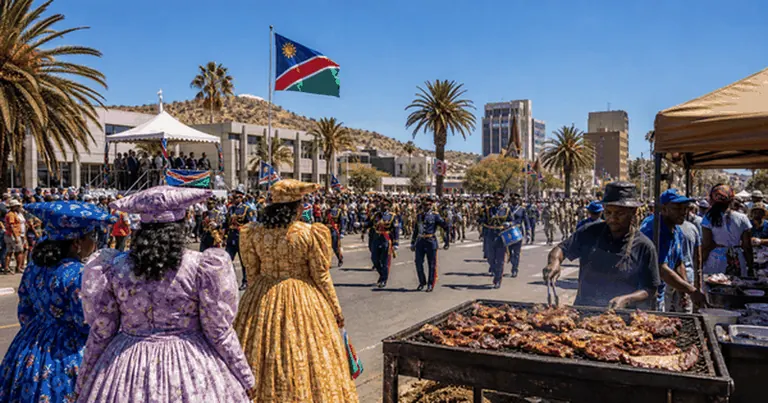
Across Namibia, the day is spacious and regional: families gather over braai, kapana, mahangu and beer, while communities from Ovambo, Herero, Nama, Damara and San backgrounds bring different histories to the national story.
The capital often hosts state parades, speeches and national performances.
Why this day
21 March marks the day in 1990 when Namibia became independent after decades of South African rule and a long liberation struggle led by SWAPO. The date ended colonial control that had passed from Germany to South Africa after World War I.
The day became the central national celebration because independence also followed the memory of the Herero and Nama genocide, apartheid administration and years of war in the north. Sovereignty is therefore tied to land, dignity and the recovery of national voice.
Today Independence Day is marked with official ceremonies, parades, speeches, music and flags, often in Windhoek or a selected regional centre. Visitors see desert landscapes, national dress, military display and a public language of reconciliation and unity.
Across Namibia, the day is spacious and regional: families gather over braai, kapana, mahangu and beer, while communities from Ovambo, Herero, Nama, Damara and San backgrounds bring different histories to the national story.
Timeline
- 1884German South West Africa declared a colony
- 1990Namibia gains independence after South African rule
- 1994Walvis Bay transferred to Namibia
Key figures
Stay for the event
Check-in 20 Mar, check-out 22 Mar 2027 — 2 nights around 21 March 2027. Change the dates to stay longer.
AREA
Find stays in WindhoekGetting there
- Celebratednationwide
- CapitalWindhoek
- Time zoneCAT (UTC+2)
Host country
- Currency: Namibian dollar
- Language: Afrikaans, German
- Driving: on the left
- Capital: Windhoek
- Phone: +264
- Emergency: 112
- Electricity: 220 V, 50 Hz, plugs D/M
What to eat
Grilled beef strips sold at markets with chilli, salsa and salt.
Pearl millet porridge eaten with meat, fish or vegetable sauces.
Slow-cooked stew prepared outdoors in a three-legged iron pot.
Dried cured meat eaten as a snack across southern Africa.
Stiff millet or maize porridge served with traditional relishes.
Atlantic fish grilled or fried along the Namibian coast.
What to drink
Crisp Namibian beer brewed under German purity traditions.
Traditional fermented millet drink from northern Namibia.
Caffeine-free red bush tea widely served in southern Africa.
Culture & traditions
The capital often hosts state parades, speeches and national performances.
Victorian-style dresses and horn-shaped headwear are powerful cultural symbols.
Dunes and desert landscapes are central to Namibia's global image.
Windhoek's museum presents the liberation struggle in monumental form.
Coming years
Namibia National Day 2028
- Tuesday 21 March 2028Next event date
Namibia National Day 2029
- Wednesday 21 March 2029Event date
Namibia National Day 2030
- Thursday 21 March 2030Event date