Kazakhstan National Day 2026


More National days
National days topic
Return to the National days index for related events.
About the event
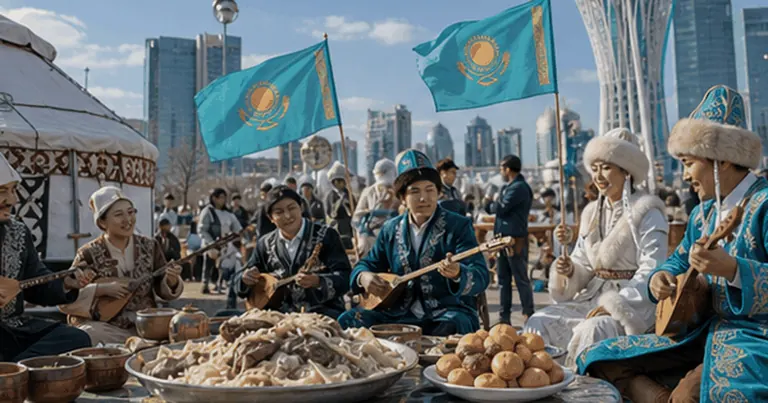
Across Kazakhstan, the holiday links city and steppe: families gather over beshbarmak, baursak and tea, while public stages present dance, nomadic heritage and modern national branding.
The two-string lute carries epic songs and national feeling.
Why this day
25 October marks Republic Day in Kazakhstan, commemorating the 1990 Declaration of State Sovereignty. The date came before full independence from the Soviet Union in December 1991 and is now used to mark the political foundation of the modern Kazakh state.
The day became important again after being restored as a national holiday in 2022. It allows Kazakhstan to emphasise sovereignty, state institutions and Kazakh identity while also recognising the country's multi-ethnic society and Soviet inheritance.
Today Republic Day is marked with concerts, official ceremonies, flags, cultural events and public celebrations in Astana, Almaty and regional centres. Visitors see sky-blue flags, eagle imagery, steppe motifs, dombra music and a formal but festive civic mood.
Across Kazakhstan, the holiday links city and steppe: families gather over beshbarmak, baursak and tea, while public stages present dance, nomadic heritage and modern national branding.
Timeline
- 1990Declaration of State Sovereignty adopted by Kazakh SSR
- 1991Kazakhstan declares independence from the Soviet Union
- 2019Capital renamed Nur-Sultan, later restored as Astana
Key figures
Stay for the event
Check-in 24 Oct, check-out 26 Oct 2026 — 2 nights around 25 October 2026. Change the dates to stay longer.
AREA
Find stays in AstanaGetting there
- Celebratednationwide
- CapitalAstana
- Time zoneALMT (UTC+5/+6)
Host country
- Currency: Kazakhstani tenge
- Language: Kazakh, Russian
- Driving: on the right
- Capital: Astana
- Phone: +7
- Emergency: 112
- Electricity: 230 V, 50 Hz, plugs C/F
What to eat
Boiled horse meat with pasta and rich broth — Kazakhstan's national dish, a nomadic heritage meal served at every celebration feast.
Roasted whole lamb cooked in a closed metal container over the fire — the Kazakh celebration meat for weddings and national days.
Thin flatbreads baked on a tava griddle and served with meat stew — the Kazakh everyday bread with nomadic steppe origins.
Lamb dumplings boiled in broth — larger and more rustic than Chinese dumplings, eaten as a main course at Kazakh celebrations.
Noodles rolled by hand with broth and boiled meat — the Kazakh version of lagman, Central Asia's most beloved noodle dish.
Fried dough pockets filled with lamb and onion — Central Asian baked or fried dumplings eaten as a celebration snack.
What to drink
Fermented mare's milk — Kazakhstan's national drink with a thousand years of nomadic tradition; served at celebrations and as a health tonic.
Fermented camel milk — thicker and more sour than kumis, drunk as a medicine and celebration drink in southern Kazakhstan.
Strong black tea with milk — drunk constantly from morning to night across Kazakhstan; the social drink of the steppe.
Culture & traditions
The two-string lute carries epic songs and national feeling.
Traditional hunting with golden eagles remains a powerful steppe symbol.
The capital hosts official Republic Day concerts and state events.
The yurt symbolises mobility, hospitality and nomadic design.
Coming years
Kazakhstan National Day 2027
- Monday 25 October 2027Next event date
Kazakhstan National Day 2028
- Wednesday 25 October 2028Event date
Kazakhstan National Day 2029
- Thursday 25 October 2029Event date