Jordan National Day 2027


More National days
National days topic
Return to the National days index for related events.
About the event
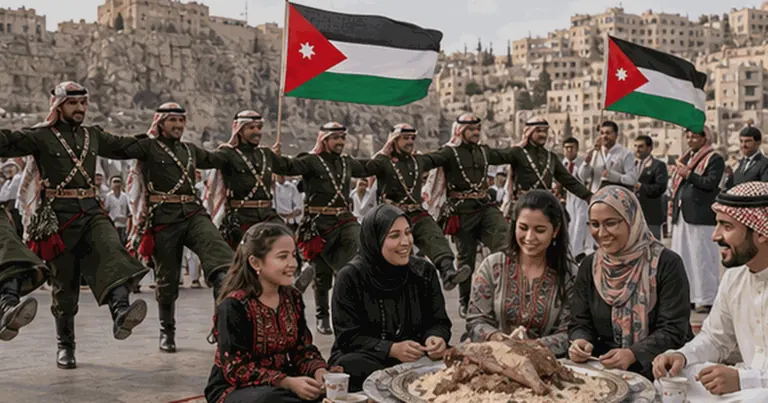
The day became Jordan's main national celebration because it marks the transition from British mandate to sovereign kingdom under Abdullah I. Mansaf, coffee, sweets, dabke, desert imagery and city lights connect the formal royal anniversary to everyday Jordanian warmth.
Petra — the Nabataean rose-red city carved from sandstone cliffs, a UNESCO World Heritage site and one of the New Seven Wonders of the World.
Why this day
25 May marks the day in 1946 when Transjordan became independent from Britain and was recognised as the Hashemite Kingdom of Jordan. The date places monarchy, statehood and Arab political history at the centre of Jordan's national story.
The day became Jordan's main national celebration because it marks the transition from British mandate to sovereign kingdom under Abdullah I. Later wars, refugee waves and regional diplomacy made stability and monarchy recurring themes in how the state presents itself.
Today Independence Day is marked with royal ceremonies, fireworks, concerts, flags and official events in Amman and across governorates. Visitors see red-white-black-green colours, portraits of the king, military ceremony and family gatherings.
Across Jordan, the day feels hospitable and social. Mansaf, coffee, sweets, dabke, desert imagery and city lights connect the formal royal anniversary to everyday Jordanian warmth.
Timeline
- 1921Emirate of Transjordan established under Abdullah I
- 1946Jordan becomes independent from Britain
- 1999King Abdullah II succeeds King Hussein
Key figures
Stay for the event
Check-in 24 May, check-out 26 May 2027 — 2 nights around 25 May 2027. Change the dates to stay longer.
AREA
Find stays in AmmanGetting there
- Celebratednationwide
- CapitalAmman
- Time zoneEET (UTC+2)
Host country
- Currency: Jordanian dinar
- Language: Arabic
- Driving: on the right
- Capital: Amman
- Phone: +962
- Emergency: 911
- Electricity: 230 V, 50 Hz, plugs B/C/D/F/G/J
What to eat
Jordan's national dish — whole lamb slow-cooked on mountains of saffron rice with almonds, pine nuts and fried onion, served on a large communal tray.
Ground lamb meatballs in a warm yoghurt sauce with rice — a Levantine classic that is a staple of Jordanian celebration cooking.
Palestinian slow-cooked chicken and caramelised onion with sumac and flatbread — deeply embedded in Jordanian-Palestinian cooking.
Minced lamb mixed with bulgur wheat and spices, shaped by hand — eaten raw like kibbeh nayyeh or fried as balls.
Falafel, hummus and mezze laid on Jordanian bread — the everyday breakfast of Amman, eaten communally at street stalls.
Slow-cooked lamb shanks in a rich stew with almonds and cinnamon — a Jordanian party dish from the Levant tradition.
What to drink
Strong Arabic coffee with cardamom — served hot in small cups without handles, the Jordanian welcome drink at every home and café.
Fresh-squeezed pomegranate juice — Jordan's most distinctive fresh juice, pressed from Karak and Aqaba pomegranates at street stands.
Thin yoghurt drink with dried mint and salt — a cooling Levantine refreshment popular across Jordan in summer.
Culture & traditions
Petra — the Nabataean rose-red city carved from sandstone cliffs, a UNESCO World Heritage site and one of the New Seven Wonders of the World.
Wadi Rum desert — the vast red sandstone and granite landscape used as Mars in countless films; Lawrence of Arabia country.
The Dead Sea — the lowest point on earth at 430 metres below sea level, where visitors float without swimming in hypersaline waters.
Jerash Roman ruins — the best-preserved Roman provincial city outside Italy, still hosting festivals in its intact oval plaza.
Coming years
Jordan National Day 2028
- Thursday 25 May 2028Next event date
Jordan National Day 2029
- Friday 25 May 2029Event date
Jordan National Day 2030
- Saturday 25 May 2030Event date