
About the event
Today the anniversary is marked with state-organised rallies, flags, speeches, revolutionary songs and public displays, especially in Tehran. 11 February marks the anniversary of the 1979 Islamic Revolution, when the Pahlavi monarchy collapsed and the Islamic Republic emerged.
Persepolis — the ceremonial capital of the Achaemenid Empire, a UNESCO site of columns, bas-reliefs and imperial grandeur near Shiraz.
Why this day
11 February marks the anniversary of the 1979 Islamic Revolution, when the Pahlavi monarchy collapsed and the Islamic Republic emerged. In Iran it is celebrated as the victory of the revolution and the founding moment of the current state.
The day became the official national revolutionary holiday because it defines the political order that followed: clerical leadership, republican institutions, anti-monarchical memory and a strong language of independence from foreign influence. It remains politically charged inside and outside Iran.
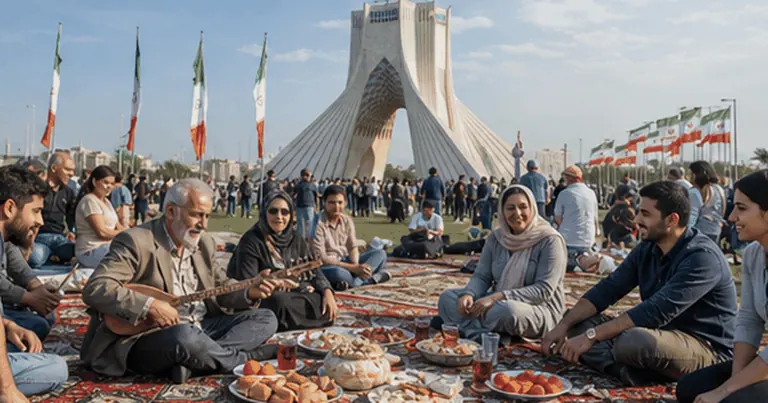
Today the anniversary is marked with state-organised rallies, flags, speeches, revolutionary songs and public displays, especially in Tehran. Visitors see a formal political celebration rather than a casual street festival, with Azadi Square as a key symbolic space.
Across Iranian families, the day sits beside a much older cultural calendar where Nowruz is the great shared celebration. Food, poetry, tea, sweets and family hospitality remain essential to understanding Iranian identity beyond state ceremony.
Timeline
- 1906Constitutional Revolution creates a parliament in Iran
- 1979Islamic Revolution triumphs as monarchy collapses
- 1980Iran-Iraq War begins and reshapes the republic
Key figures
Stay for the event
Check-in 10 Feb, check-out 12 Feb 2027 — 2 nights around 11 February 2027. Change the dates to stay longer.
AREA
Find stays in TehranGetting there
- Celebratednationwide
- CapitalTehran
- Time zoneIRST (UTC+3:30)
Host country
- Currency: Iranian rial
- Language: Persian (Farsi)
- Driving: on the right
- Capital: Tehran
- Phone: +98
- Emergency: 110
- Electricity: 220 V, 50 Hz, plugs C/F
What to eat
Slow-cooked pomegranate and walnut stew with duck or chicken — one of the world's great sauce traditions, from the Caspian coast.
Herb-heavy Persian frittata with fenugreek, dried barberries and walnuts — eaten at Nowruz and national celebrations.
Lamb shank on saffron rice with dried barberries (zereshk) — Iran's most beloved presentation of the pilaf tradition.
Ash-e reshteh lentil and herb noodle soup — eaten at Persian New Year as a symbol of good fortune.
Lamb or chicken skewers marinated in saffron and lemon, grilled over charcoal — the most popular Iranian street dish.
Lamb slow-cooked in a clay pot with tomato, potato and spices — a thick Persian stew served in its cooking vessel.
What to drink
Cold yoghurt drink diluted with water and flavoured with dried mint and salt — Iran's most widely consumed refreshment.
Black tea brewed very strong and served with a sugar cube held in the cheek — the Iranian social ritual, consumed hourly.
Sour cherry syrup diluted with cold water — a bright red Iranian summer drink from the country's famous morello cherry orchards.
Culture & traditions
Persepolis — the ceremonial capital of the Achaemenid Empire, a UNESCO site of columns, bas-reliefs and imperial grandeur near Shiraz.
Nowruz — Persian New Year on the spring equinox, celebrated by 300 million people across Central Asia; the most ancient living calendar festival.
Persian carpet weaving — UNESCO-listed; Iranian carpets from Tabriz, Isfahan and Kashan are among the world's most valuable handmade objects.
Hafez and Rumi — Iran's poet-philosophers whose words are cited daily in ordinary conversation; the Tomb of Hafez in Shiraz is a pilgrimage site.
Coming years
Iran National Day 2028
- Friday 11 February 2028Next event date
Iran National Day 2029
- Sunday 11 February 2029Event date
Iran National Day 2030
- Monday 11 February 2030Event date