China National Day 2027


More National days
National days topic
Return to the National days index for related events.
About the event
Across China, the holiday is also practical: families travel, visit scenic sites, shop, eat banquet food and watch state broadcasts. Its meaning is strongly tied to Communist Party rule, national rejuvenation, military display and modern state power.
The Beijing ceremony is the symbolic centre of National Day.
Why this day
1 October marks the day in 1949 when Mao Zedong proclaimed the People's Republic of China from Tiananmen Gate in Beijing. The date ended the Chinese Civil War on the mainland and created the state that governs mainland China today.
The day became the central state holiday of the People's Republic and begins Golden Week, one of the world's largest annual travel periods. Its meaning is strongly tied to Communist Party rule, national rejuvenation, military display and modern state power.
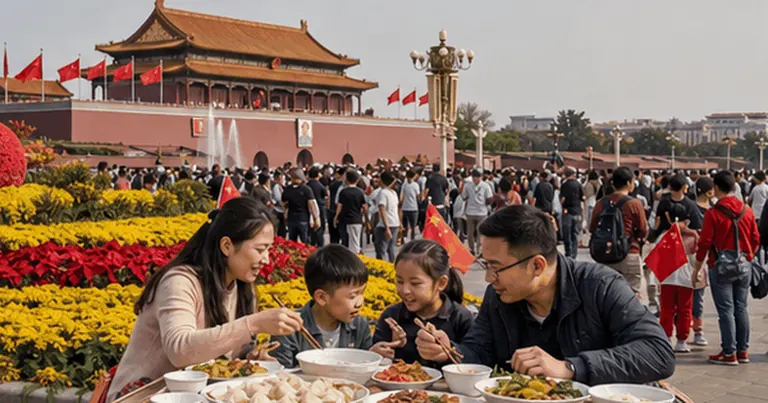
Today National Day is marked with flag-raising at Tiananmen Square, official ceremonies, patriotic media, lights, tourism and occasional large military parades on major anniversaries. Visitors see red flags, floral displays, crowded landmarks and a carefully choreographed public atmosphere.
Across China, the holiday is also practical: families travel, visit scenic sites, shop, eat banquet food and watch state broadcasts. It is both a political anniversary and a mass domestic travel season.
Timeline
- 1911Xinhai Revolution begins the fall of the Qing dynasty
- 1949People's Republic of China proclaimed in Beijing
- 1978Reform and opening begins under Deng Xiaoping
Key figures
Stay for the event
Check-in 30 Sep, check-out 2 Oct 2026 — 2 nights around 1 October 2026. Change the dates to stay longer.
AREA
Find stays in BeijingGetting there
- Celebratednationwide
- CapitalBeijing
- Time zoneCST (UTC+8)
Host country
- Currency: Chinese yuan
- Language: Chinese
- Driving: on the right
- Capital: Beijing
- Phone: +86
- Emergency: 110
- Electricity: 220 V, 50 Hz, plugs A/I
What to eat
Crisp roast duck with pancakes, scallions and bean sauce from Beijing.
Dumplings filled with pork, vegetables or seafood for family gatherings.
Long noodles symbolising long life, served at festive meals.
Shared simmering broth with meat, vegetables, tofu and dipping sauces.
Dense filled pastries associated with Mid-Autumn Festival but widely gifted.
Pork belly cooked with soy, sugar and aromatics for rich banquet flavour.
What to drink
Green, oolong and pu-erh teas structure meals and hospitality.
Strong grain spirit used for formal toasts and banquets.
Sour plum drink served cold with meals in warm weather.
Culture & traditions
The Beijing ceremony is the symbolic centre of National Day.
Millions travel domestically, filling trains, parks and historic sites.
The imperial palace anchors Beijing's national historical landscape.
Festival performances use movement, drums and colour in public celebrations.
Coming years
China National Day 2028
- Sunday 1 October 2028Next event date
China National Day 2029
- Monday 1 October 2029Event date
China National Day 2030
- Tuesday 1 October 2030Event date