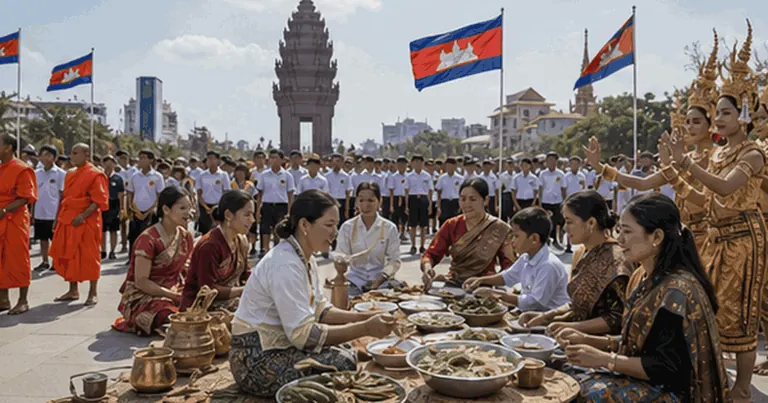
Cambodia National Day 2026


More National days
National days topic
Return to the National days index for related events.
About the event
The date is strongly linked to King Norodom Sihanouk, who campaigned diplomatically for independence and returned as the public face of restored sovereignty. Families gather around rice, fish amok, noodles and fruit, while television and public spaces carry patriotic music and ceremonial images.
Phnom Penh's lotus-shaped monument is the main ceremony site.
Why this day
9 November marks the day in 1953 when Cambodia gained independence from France. The date is strongly linked to King Norodom Sihanouk, who campaigned diplomatically for independence and returned as the public face of restored sovereignty.
The day became Cambodia's central national holiday because it sits between the older memory of the Khmer Empire and the painful modern history of war, the Khmer Rouge and reconstruction. Independence is celebrated through monarchy, state ceremony and cultural survival.
Today Independence Day is marked with ceremonies at Independence Monument in Phnom Penh, royal and government participation, flags, parades and fireworks. Visitors see saffron robes, school groups, the red-blue flag and references to Angkor as the deep symbol of the nation.
Across Cambodia, the day is calmer than Khmer New Year but still visible. Families gather around rice, fish amok, noodles and fruit, while television and public spaces carry patriotic music and ceremonial images.
Timeline
- 1863Cambodia becomes a French protectorate under King Norodom
- 1953King Norodom Sihanouk secures independence from France
- 1993Monarchy restored after UN-backed elections
Key figures
Stay for the event
Check-in 8 Nov, check-out 10 Nov 2026 — 2 nights around 9 November 2026. Change the dates to stay longer.
AREA
Find stays in Phnom PenhGetting there
- Celebratednationwide
- CapitalPhnom Penh
- Time zoneICT (UTC+7)
Host country
- Currency: Cambodian riel
- Language: Khmer
- Driving: on the right
- Capital: Phnom Penh
- Phone: +855
- Emergency: 117
- Electricity: 230 V, 50 Hz, plugs A/C/G
What to eat
Coconut fish curry steamed in banana leaves with kroeung spice paste.
Rice noodles with green fish curry and fresh herbs.
Stir-fried beef with lime-pepper sauce and salad.
Rice noodle soup with pork, herbs and clear broth.
Fermented fish dip cooked with pork and coconut milk.
Sticky rice and banana parcels wrapped in leaves for festivals.
What to drink
Fresh pressed cane juice served cold in streets and markets.
Popular Cambodian lager commonly served at restaurants and gatherings.
Strong coffee with condensed milk, served cold in the heat.
Culture & traditions
Phnom Penh's lotus-shaped monument is the main ceremony site.
Classical Khmer dance preserves courtly gesture, costume and mythology.
The temple complex is the country's defining historical and visual symbol.
Boat races and river celebrations show Cambodia's seasonal public culture.
Coming years
Cambodia National Day 2027
- Tuesday 9 November 2027Next event date
Cambodia National Day 2028
- Thursday 9 November 2028Event date
Cambodia National Day 2029
- Friday 9 November 2029Event date