Bhutan National Day 2026


More National days
National days topic
Return to the National days index for related events.
About the event
Later reforms turned Bhutan into a constitutional monarchy, but National Day still revolves around royal presence and the continuity of the Wangchuck dynasty. The date is Bhutan's National Day because it created the modern monarchy that unified the country and still anchors public identity.
The king's National Day speech is the ceremony's emotional centre.
Why this day
17 December marks the coronation of Ugyen Wangchuck as Bhutan's first hereditary king in 1907. The date is Bhutan's National Day because it created the modern monarchy that unified the country and still anchors public identity.
The day became the central national celebration in a country where monarchy, Buddhism and statehood are closely linked. Later reforms turned Bhutan into a constitutional monarchy, but National Day still revolves around royal presence and the continuity of the Wangchuck dynasty.
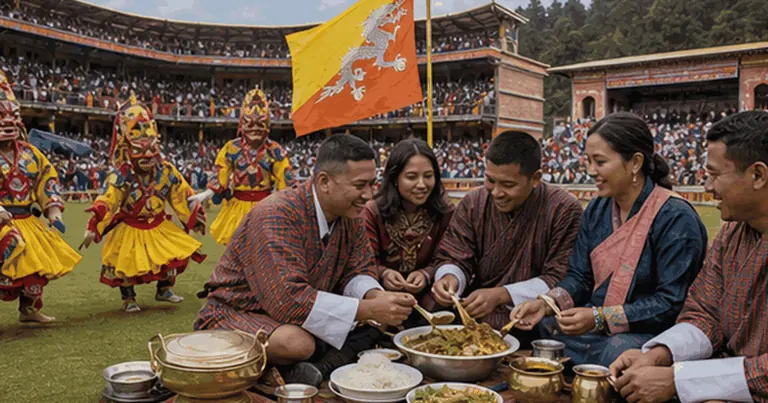
Today National Day is marked with a major public ceremony, royal address, prayers, dances, awards and flags, often at a stadium or dzong. Visitors see gho and kira dress, monastic rituals, archery culture and mountain-backed pageantry.
Across Bhutan, the day is dignified rather than loud. Families watch broadcasts, gather in local towns, wear national dress and share ema datshi, rice, tea and butter-laced hospitality.
Timeline
- 1907Ugyen Wangchuck crowned as Bhutan's first hereditary king
- 2008Bhutan becomes a constitutional monarchy with elections
- 1974King Jigme Singye Wangchuck opens Bhutan wider to the world
Key figures
Stay for the event
Check-in 16 Dec, check-out 18 Dec 2026 — 2 nights around 17 December 2026. Change the dates to stay longer.
AREA
Find stays in ThimphuGetting there
- Celebratednationwide
- CapitalThimphu
- Time zoneBTT (UTC+6)
Host country
- Currency: Bhutanese ngultrum
- Language: Dzongkha
- Driving: on the left
- Capital: Thimphu
- Phone: +975
- Emergency: 112
- Electricity: 230 V, 50 Hz, plugs C/D/F/G/M
What to eat
Chilli and cheese stew, widely treated as Bhutan's national dish.
Pork cooked with chillies, radish or greens for hearty meals.
Spicy minced chicken stew with tomato, garlic and ginger.
Nutty Bhutanese rice grown in high valleys and served with curries.
Steamed dumplings filled with meat or cheese and served with chilli.
Fried biscuits prepared for festive and religious occasions.
What to drink
Butter tea with salt, central to highland hospitality.
Traditional distilled or fermented grain drink served in some homes.
Sweet milk tea common in towns and family settings.
Culture & traditions
The king's National Day speech is the ceremony's emotional centre.
Fortress-monasteries frame public ritual and state authority.
The national sport brings competition, song and community pride.
Masked Buddhist dances appear at festivals and ceremonial events.
Coming years
Bhutan National Day 2027
- Friday 17 December 2027Next event date
Bhutan National Day 2028
- Sunday 17 December 2028Event date
Bhutan National Day 2029
- Monday 17 December 2029Event date